RV carport with storage: what I learned pricing one for my lot
By Dale Pruitt · September 14, 2026
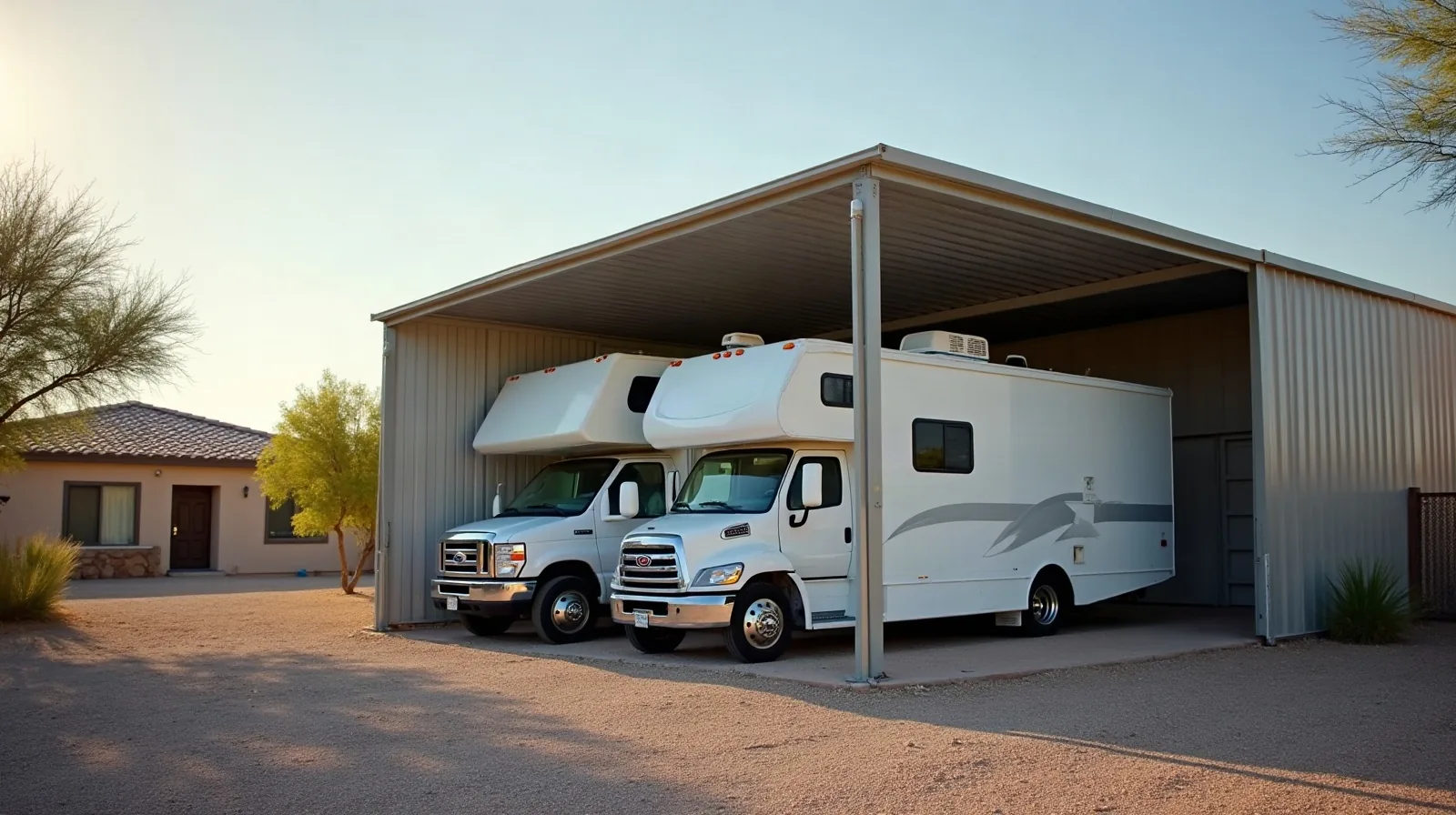
Last June I stood in my side lot in Mesa with a tape measure, a city setback sheet, and the bright idea I’d never pay for covered storage again. The quote came to $11,400 for a 16x40 steel carport with a 12x16 enclosed room. Then the city told me the corner setback ate nine feet. Whole layout dead. I still pay $135 a month for covered RV storage in Phoenix every summer. So when people ask me about pricing an RV carport with storage, I tell them the dream hits local code before it ever hits your wallet.
What “RV carport with storage” actually means
A carport with storage isn’t a garage. It’s a roof over the rig and a lockable box for your junk. The box can be an enclosed room on one end, a lean-to along the side, or a small shed at the back.
When I got quotes in Mesa, evry salesman called that box a utility room. 12x16 was the cheapest add-on at $2,800. A full lean-to ran $1,900 but gave me less security.
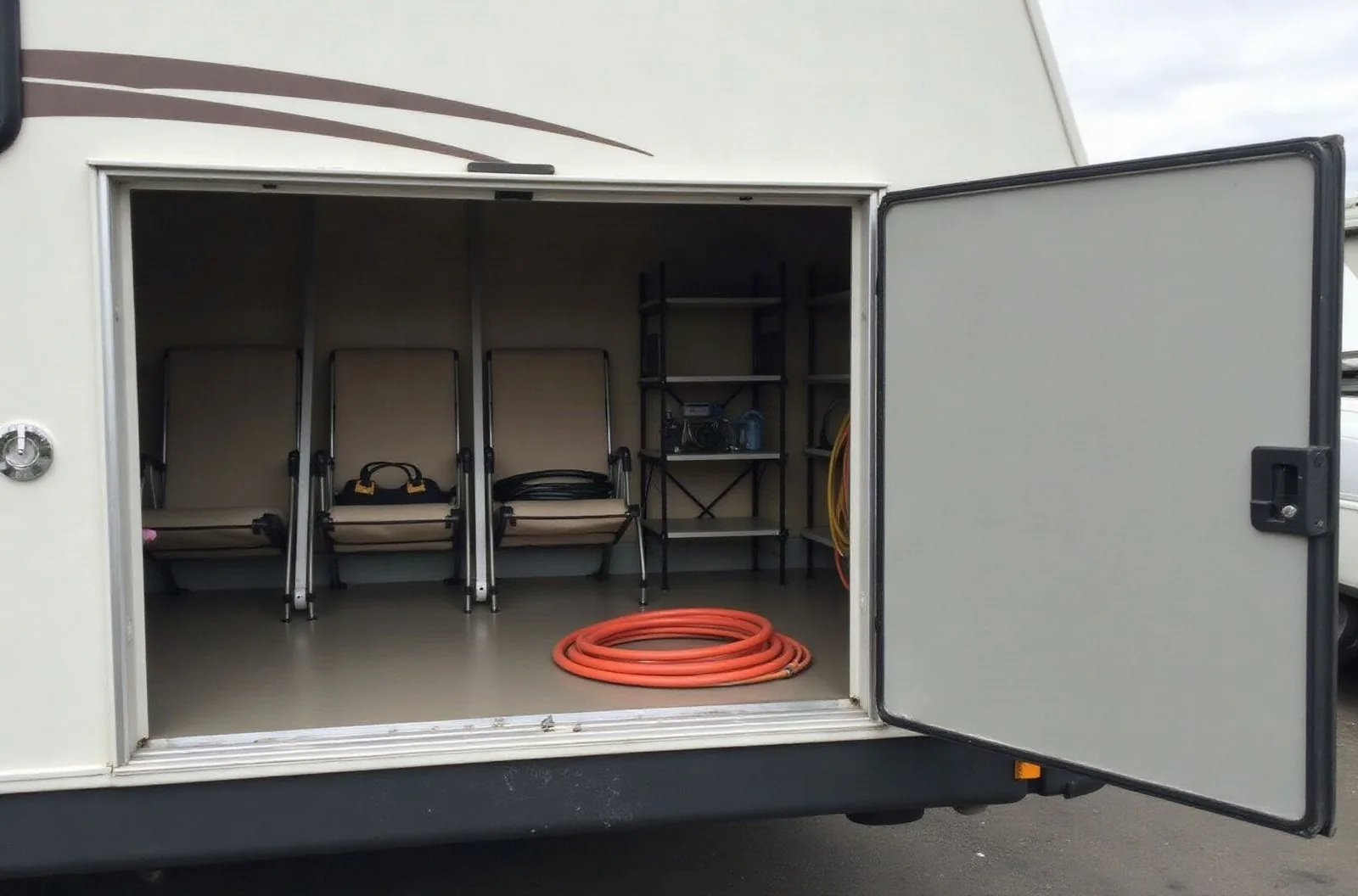
- Enclosed room: tools, batteries, sewer hoses, chairs
- Lean-to: shade for a workbench or secound vehicle
- Shed: cheapest, often not tied into the carport frame
If you just want shade, skip the storage. If you want to stop renting a storage unit, pay for the room.
That room is the difference between a $7,000 carport and an $11,000 project. I almost ordered the cheap one. Glad I didn’t, because sizing the whole thing wrong is the next trap.
Sizing it for a Class A or fifth wheel
My coach is 36 feet bumper to ladder. I spec’d the carport at 16 feet wide, 40 feet long, with 14-foot legs. That’s the minimum I’d accept for a diesel pusher.
Most people forget the AC shroud: a Class A sits 12 to 13.5 feet tall, and with six inches for concrete pad slope, you need 14-foot legs or higher.
Before you order, read our post on RV storage size and go measure the actual rig. Brochure length lies. My 36-footer is really 38 feet 4 inches with the hitch and ladder.
| Rig type | Leg height | Width | Length |
|---|---|---|---|
| Class A | 14 ft | 16 ft | 40 ft |
| Fifth wheel | 14 ft | 16 ft | 35-40 ft |
| Travel trailer | 12 ft | 14 ft | 25-35 ft |
| Class C | 12 ft | 14 ft | 28-32 ft |
Wider is better. 16 feet lets you open slide-outs a little and walk around. 12 feet feels like a tomb. And none of those dimensions matter if the frame can’t take the wind.
I found this video helpful for sizing a carport, so I’m passing it along.
Gauge, wind, snow, and permits
Steel carport prices swing on three things: panel gauge, wind certification and snow load. My Mesa quote was for 26-gauge vertical roof, 115 mph wind, zero snow. That cost $6,800 base.
A 29-gauge carport would’ve saved $1,200. But a monsoon gust in July hits 70 mph before the dust hits your windshield. I don’t buy the cheap frame.
Every city I’ve checked requires a permit. The fee in Mesa was $340. HOAs are a seperate fight. Some ban RV carports outright.
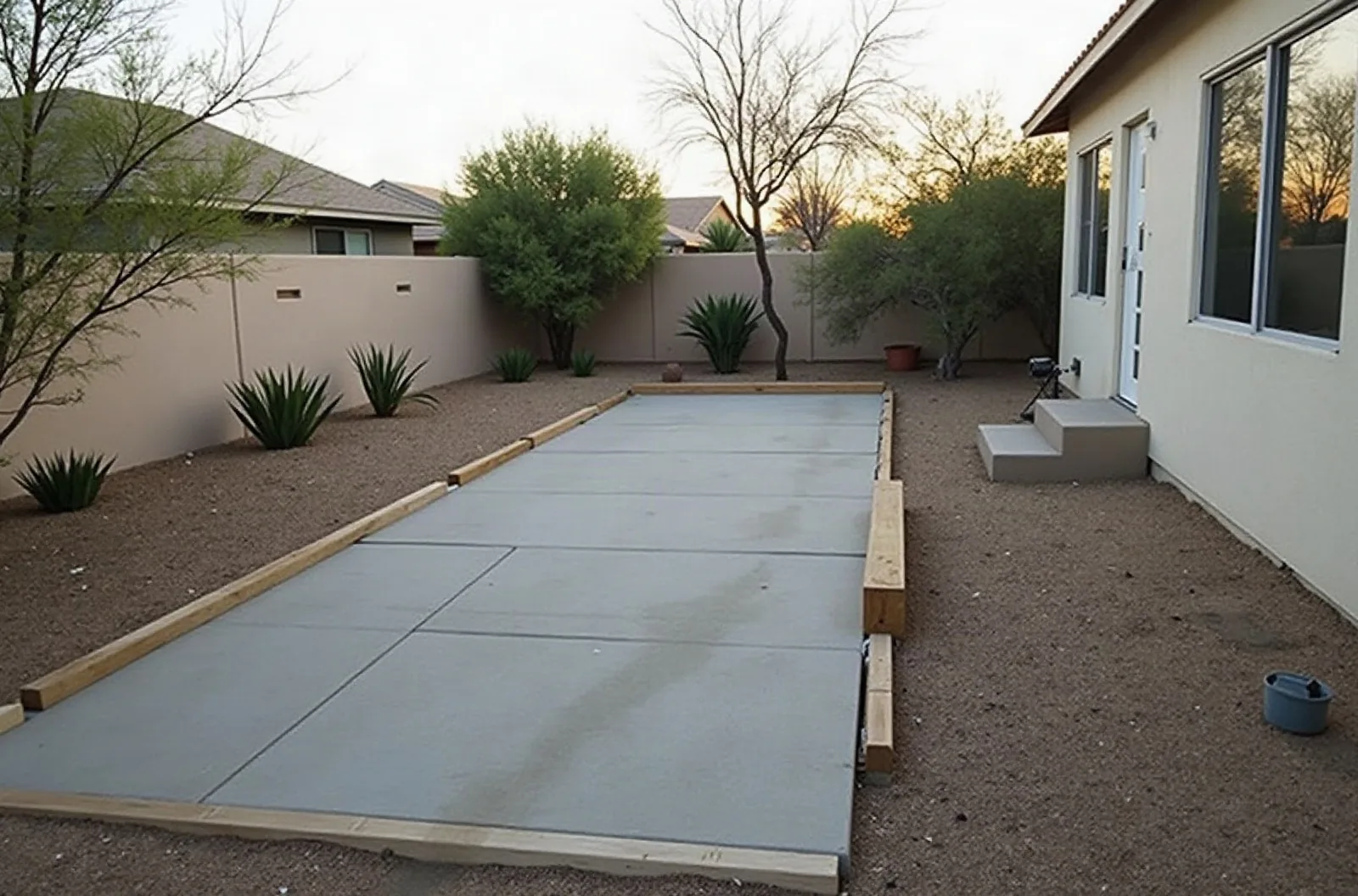
Your concrete or gravel pad is extra. Concrete runs $6 to $12 a square foot. For a 16x40 pad, that’s $3,840 to $7,680. Gravel is $1 to $3 a foot.
I budgeted $3,000 for concrete. The final quote was $5,200 because my lot needed grading. That killed the project faster than the setback did. Which is where the payback math gets ugly.
The payback math against renting
In Phoenix, covered storage for a big Class A runs $100 to $200 a month. I pay $135. Yearly, that’s $1,620.
A certified steel carport with a storage room on my lot would’ve cost $11,400 for the structure, $5,200 for concrete, $340 for the permit, maybe $500 for electrical. Total: $17,440.
$17,440 divided by $1,620 is 10.8 years to break even. That’s before repair or replacement costs.
But the spreadsheets don’t line up with real life. My storage lot is 4.2 miles from my house. The carport would be 40 feet from my coffee maker. I cant put a price on walking out at 6 a.m. And not driving accross town.
Live somewhere cheaper and the math flips. Check rates for your area. When I looked at RV storage in Las Vegas, uncovered lots were $50 a month. A $15,000 carport against fifty bucks a month is a lousy investment by any measure. But before you even run the numbers, your lot has to pass the city’s tape measure test.
The Mesa setback that killed my layout
My side lot is 14 feet wide. The city wants a 5-foot side setback and a 15-foot front setback from the curb. I’d have started the 40-foot carport at that front setback and run it 25 feet into the rear yard.
Rear yard’s 28 feet deep. A 40-foot carport wouldn’t fit. A 30-footer would’ve covered my 36-foot coach? Six feet of nose sticking out.
I looked at a lean-to on the back of the carport instead. That pushed the structure farther into the yard. The city denied the variance. I gave up.
Lesson: before you drop $500 on drawings, walk the lot with the city’s setback table. Tape measure, not hope.
HOA docs are in the same pile. A friend in Chandler got his carport approved by the city and then fined $100 a week by the HOA for a “portable structure.” He won. Eventually. I didn’t want that fight, which is why the storage lot still gets my check.
Why I still rent covered storage in summer
I’m a snowbird. May through October I’m in Mesa. The coach sits in a covered space at a big lot off the 202. $135 a month plus a $25 admin fee every year.
Could I keep it in my driveway? The HOA says 72 hours max for loading. After that, the tow truck comes.
So for six months I rent. For the six months I’m gone, the coach stays in Mesa too. I fly back and forth. The carport dream was for the other half of my life.
The real question isn’t carport versus storage. It’s where you live and how long you’ll stay. If I planned to be in this house ten more years, I’d pour the concrete and fight the city. I don’t.
For more ideas on keeping the rig close to home, our post on RV storage ideas covers nine places to park when the HOA says no. Including some I hadn’t considered.
What I’d do differently next time
I’d start with the concrete pad. Not the steel order, not the permit, the pad. A 16x40 concrete slab is useful even without a roof. It’s a clean place to wash the coach, change oil, or park the truck. If the carport dies, the pad doesn’t.
Second, I’d get three quotes, not five. I wasted two weeks waiting for a salesman who never showed. The local crew that quoted $11,400 could’ve done it for $10,200 if I’d ordered in August, their slow month.
This weekend, do one thing. Measure your rig’s total length and height. Then call two local carport companies and ask for a rough quote over the phone. Most will give you a ballpark if you have the size. Then check your city setback table online. That’s an hour of work that saves a $2,000 mistake.
And if the carport doesn’t pencil out, go price a covered RV carport with storage at a big lot near you. Sometimes renting is the smarter money.
Keep reading
FAQ
How much does an RV carport with storage cost in Arizona?
Rough installed price runs $8,000 to $15,000 for a 16x40 steel carport with a 12x16 enclosed utility room, certified for wind. Concrete adds $4,000 to $8,000. Exact price depends on gauge, height, and local steel costs. Get three quotes and check permit fees before ordering.
What is the best size RV carport for a Class A motorhome?
Go 16 feet wide, 40 to 45 feet long, with 14-foot legs. That clears the AC shroud on most Class A rigs and gives room to walk around. If your rig is over 38 feet length 45 feet. Measure your actual bumper-to-ladder length befor ordering.
Do I need a permit for an RV carport?
Almost always yes. Most cities require a building permit and wind certification. Fees commonly run $200 to $500. Your HOA may also require approval, and some ban RV carports entirely. Check both before spending money on drawings.
Is it cheaper to build an RV carport or rent storage?
Depends on monthly rent and build cost. At $150 a month for covered storage, a $15,000 carport takes 8 to 10 years to break even. At $300 a month, its 4 to 5 years. If you plan to stay in the house long term, building may win. If not, rent.
What does a concrete pad for an RV carport cost?
Concrete runs $6 to $12 per square foot installed. A 16x40 pad is 640 square feet, so roughly $3,840 to $7,680. Grading and drainage can add more. A compacted gravel pad is cheaper, $1 to $3 per square foot, but less durable.
Can I put an RV carport on a gravel pad?
Yes, if the ground drains well and you don't mind some settling. Gravel costs $1 to $3 per square foot, a fraction of concrete. Use a compacted base and edge restraints. But a heavy Class A may rut gravel over time, so concrete is better for long-term use.
Find storage near you
Compare covered, indoor and open RV storage in your city, then ask a few places for their current monthly rate.
Browse by state