RV storage cover buying guide: what kept my trailer clean
By Rhonda Keel · September 26, 2026
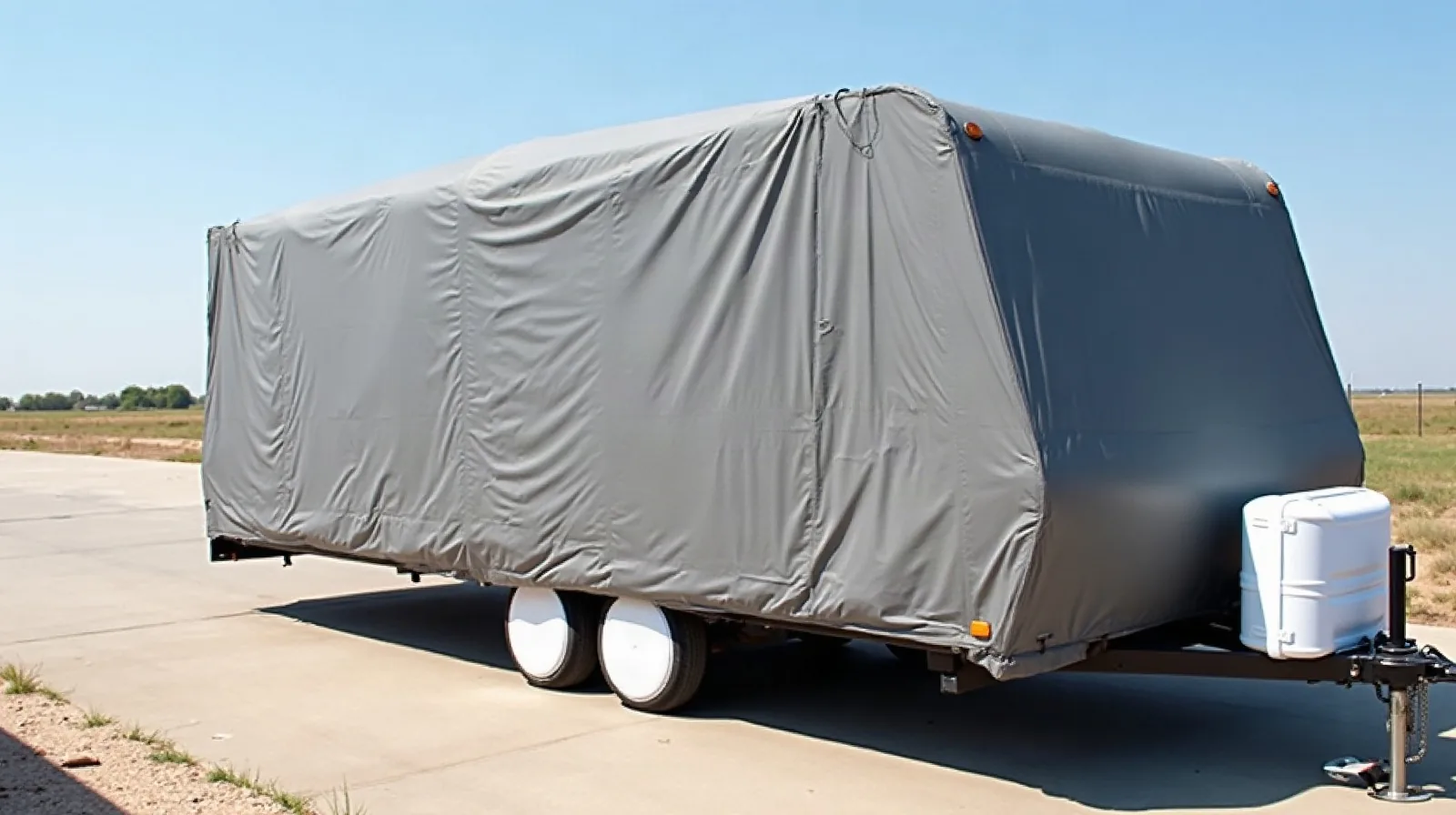
Last July I was out in the driveway holding a tennis ball on a rope while my husband wrestled a cover over our 28-foot bunkhouse travel trailer. The pavement was already going wavy from the heat and the only thing between our roof and a proper Texas summer was a box we’d ordered online. Our neighbor keeps his fifth wheel at an outdoor RV storage lot in San Antonio and he told me he gave up on covers years ago, but I wasn’t about to watch our decals go chalky white. That first summer taught me a cheap cover is worse than no cover at all.
When you actually need an RV storage cover
A cover earns it’s keep on an open lot or a driveway where UV, tree sap, bird droppings and hail can get at the rig. If you’re parked under a metal canopy or inside an enclosed unit, a full cover is usually overkill.
For open storage, the cover does three jobs: blocks UV, buffers hail, and keeps the roof clean. In a fully covered space, all you really need is tire covers and maybe a roof vent cover if you’re not winterizing.
Sizing a cover by RV type and true length
Measure the actual length from the rear bumper to the tip of the hitch or tongue, including any accessories. The brochure length is not the cover length.
| RV type | Typical length | Cover notes |
|---|---|---|
| Travel trailer | 15 to 35 ft | Covers often sold in 3-foot increments; choose the next size up if between |
| Fifth wheel | 25 to 45 ft | Taller nose needs extra panel height; look for ‘fifth wheel’ style covers |
| Class A motorhome | 25 to 45 ft | Full-body cover with zippered panels for the door and engine access |
| Class C | 20 to 35 ft | Cabover bunk adds height; measure to the top of the AC shroud |
| Class B van | 17 to 24 ft | A fitted van cover works; generic ‘small RV’ covers are too loose |
Our 28-foot bunkhouse takes the 28-31 foot size. Still leaves room for the spare tire on the back bumper.
Putting the cover on: clean, dry, and no ladders
Takes about an hour with two peopel. Alone it’s a two-hour yoga class on a hot roof.
- Pad sharp corners: gutter spouts, ladder rungs, the corners of the awning arms. I cut up foam pipe insulation from the hardware store for ours.
- Close all vents and windows, and make sure the awning is dry before rolling it up.
- Lay the cover on the roof first, then unfold the sides. Never drag it up from the ground like your making a bed.
- Strap it snug. A loose cover flaps in the wind and rubs the clear coat. Spring winds can hit 40 mph on a calm day, so we double-strap the middle.
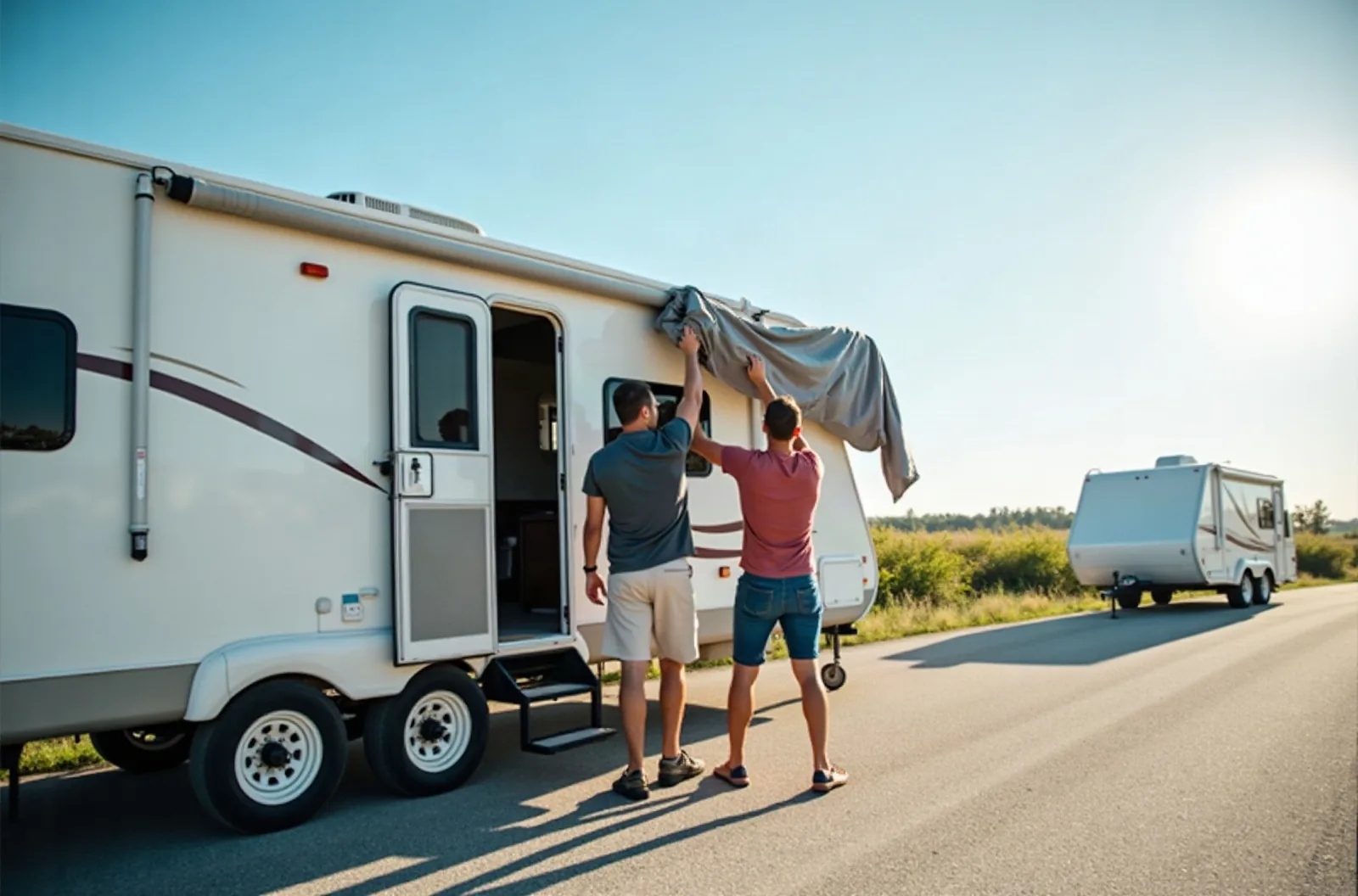
I watched a few videos before we tried it ourselves, and this one made the whole process feel less intimidating.
How long an RV storage cover lasts in UV
A snugly strapped cover lasts much longer than one left loose to flap. A flapping cover scuffs more than a light rain.
- The fabric feels thin or brittle when you bunch it up.
- You see holes or the straps are frayed.
- Water no longer beads on the surface, so the water-repellent coating is gone.
In covered storage you don’t need a full cover, but tire covers still matter. UV kills sidewalls faster than tread, and a set of four covers runs about $25. That’s cheap compared to a blowout on the highway because the tire sat uncovered in an open lot for three years.
Covered storage vs an RV cover: what I’d do now
Ive toured a few covered RV storage lots in Austin where the steel canopies are 14 feet tall and the spaces are concrete. For a Class A or a tall fifth wheel, that kind of clearance matters more than any cover. And as I wrote in our post on outdoor RV storage, open lots are fine for a month, but a summer of sun will fade the cap and crack the decals faster than you’d think.
So here’s my rule: if the RV is outside for more than 60 days between trips, cover it. If it’s outside and you’re not willing to wash it befor covering, don’t cover it at all.
What to do to the RV before the cover goes on
For a longer walkthrough, check our post on how to prepare an RV for storage.
- Dump and flush the holding tanks, then add a little water with tank treatment if you prefer to keep the seals from drying out.
- Disconnect the battery or hook up a maintainer. Our trailer has a cut-off switch, so I flip it.
- Inflate the tires to the pressure on the RV’s tire placard, then put on the tire covers.
A tire that loses 10 PSI over three months and sits on a hot Texas driveway can develop flat spots. I used to skip the tires, and our last set lasted four years instead of six.
Straps, padding, and the cheap tarp mistake
I use three belly straps: one up front, one mid-body, one at the rear. The covers with a cinch strap at the bottom front and rear do the best job. On windy days, extra straps crossed under the trailer keep the sides from lifting.
For padding, I cut up an old yoga mat and wrap the corners of the gutter spouts and the ladder. A friend of ours uses foam pipe insulation on the rear cap of his fifth wheel, where the cover tends to wear thin from wind vibration.
All of that costs about $15 at the hardware store. One of those cheap routines that pays for itself after a single hail season.
What an RV storage cover costs and what you get
- $600 custom-fit cover for a 40-foot Class A from a specialty retailer: a friend’s purchase, still looks good after four years in New Mexico sun.
The price jumps when you go custom, but the fit is the difference between a cover that works and one that acts like a sail. I’d rather pay a bit more for a cover that fits our floor plan than less for a universal that pulls tight on the corners and loose on the sides.
We take ours off when a storm with 50 mph gusts is forecast, and that’s saved us at least one warranty claim.
What I’d tell you over coffee
This weekend, stand in front of your RV and check the roof line. If you can see the AC shroud or the vent covers fading, that’s UV damage allready. And if you’re not up for the wrestle, call a few storage lots and ask about covered spaces with 14-foot clearance. Even a month under a canopy gives the paint a break.
Check rates for your own city, and do the math on cover vs covered space. Your roof will thank you in five years.
More from the lot
FAQ
Can I use a cheap tarp as an RV cover?
No. A plastic tarp traps moisture against the RV, causing mildew and corrosion. The tarp also flaps in wind and rubs the paint, leaving cloudy marks. A breathable RV cover made of multi-layer polypropylene lets moisture escape while blocking UV and rain. It costs more upfront, but it won't ruin your finish.
How tight should an RV cover be?
Snug but not stretched. You should be able to slide your hand between the cover and the RV, but there shouldn't be loose folds. Use all the belly straps and cinch them down. A flapping cover causes more paint damage than no cover at all. In high wind, add extra straps or remove the cover.
How long does an RV cover last?
Two to four seasons in full sun, depending on fabric quality. A $150 cover might last two summers; a $500 cover with a longer warranty could go four or more. When the fabric feels brittle or water no longer beads on the surface, it's time to replace it.
Should I cover my RV if it's stored under a metal carport?
No. Under a canopy, the RV is already protected from rain and most UV. A full cover can trap moisture in that dry shade and is unnecessary. Tire covers are still a good idea becuase UV, reflected light and ozone attack sidewalls even in shade.
Do I need to wash my RV before covering it?
Yes. Dirt and debris under the cover will scratch the paint and roof membrane over time. Wash the roof and sides, let everything dry completly, then put on the cover. At minimum, hose off the roof and wipe down the sides. Never cover a dirty or wet RV.
What size RV cover do I need?
Measure the actual length from the rear bumper to the tip of the hitch or tongue, including any accessories. Add a foot and choose a cover sized for that length, not the brochure length. Most covers are sold in 3-foot increments; if in between, go up a size.
Find storage near you
Compare covered, indoor and open RV storage in your city, then ask a few places for their current monthly rate.
Browse by state