RV storage cost: what people actually pay per month, by type
By Jenna Halvorsen · September 7, 2026 · updated September 10, 2026
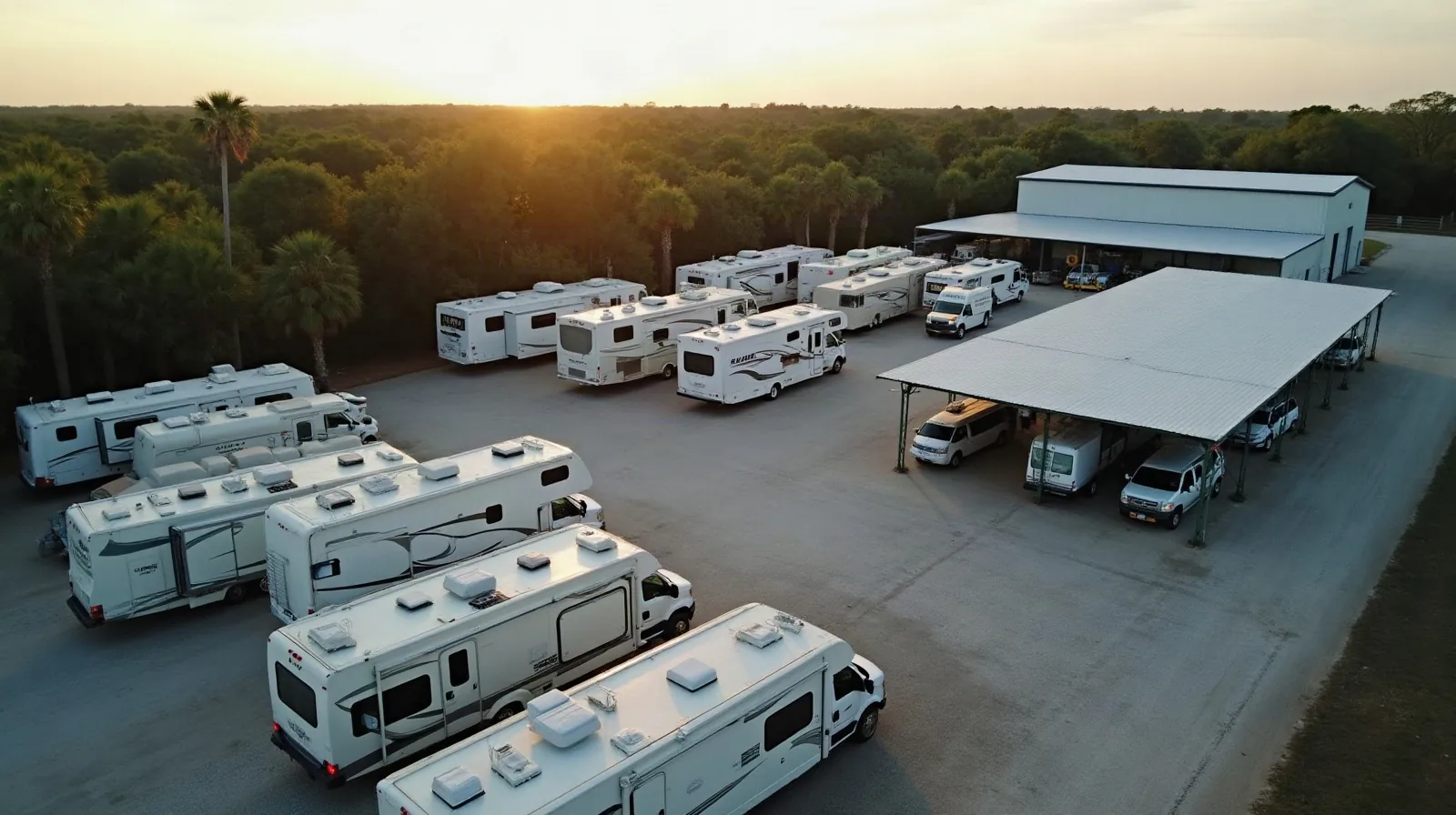
The first time I pulled my 24-foot Class C into a storage lot in Fort Myers, it was about 90 degrees in the middle of November and I was already sweating through my shirt, much like the RV storage prices in Tampa I’d been comparing. The manager handed me a clipboard and rattled off a monthly number that was $40 more than what their website listed. “Admin fee, lock, and you need insurance,” she said, already turning toward the next person in line. I just stood there in the heat trying to figure out where the extra money was coming from. That was my crash course in how RV storage cost is almost never just the rent.
I ran that front desk for four years, and the question I answered most wasn’t “Do you have space?” It was “What will this actually cost me?” RV storage prices in Tampa work the same way: a low rate online, then fees stacked on before you ever back through the gate.
RV storage cost by type: the monthly ranges
Most lots charge for space, not amenities. So the first thing that matters is how much roof you get over your rig. These are the numbers I saw working in Southwest Florida, plus the listings I still track now.
| Storage type | Typical monthly cost | What you get |
|---|---|---|
| Outdoor / uncovered | $30 to $150 (coastal metros can hit $150 to $300) | A paved or gravel slot in a fenced lot, often no roof |
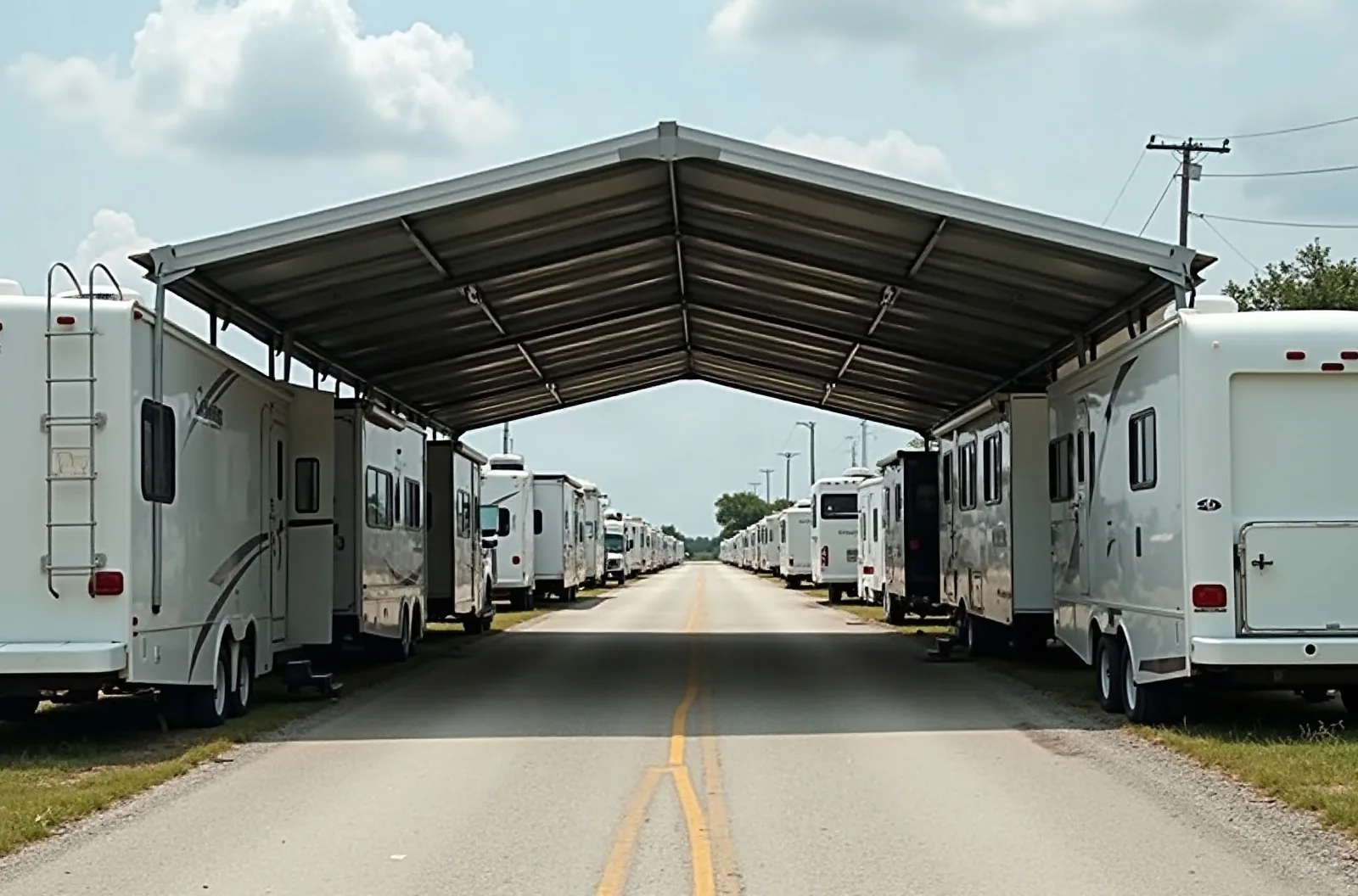
| Covered canopy | $75 to $300 (commonly $100 to $200) | Open-sided steel roof, shade, some rain protection |
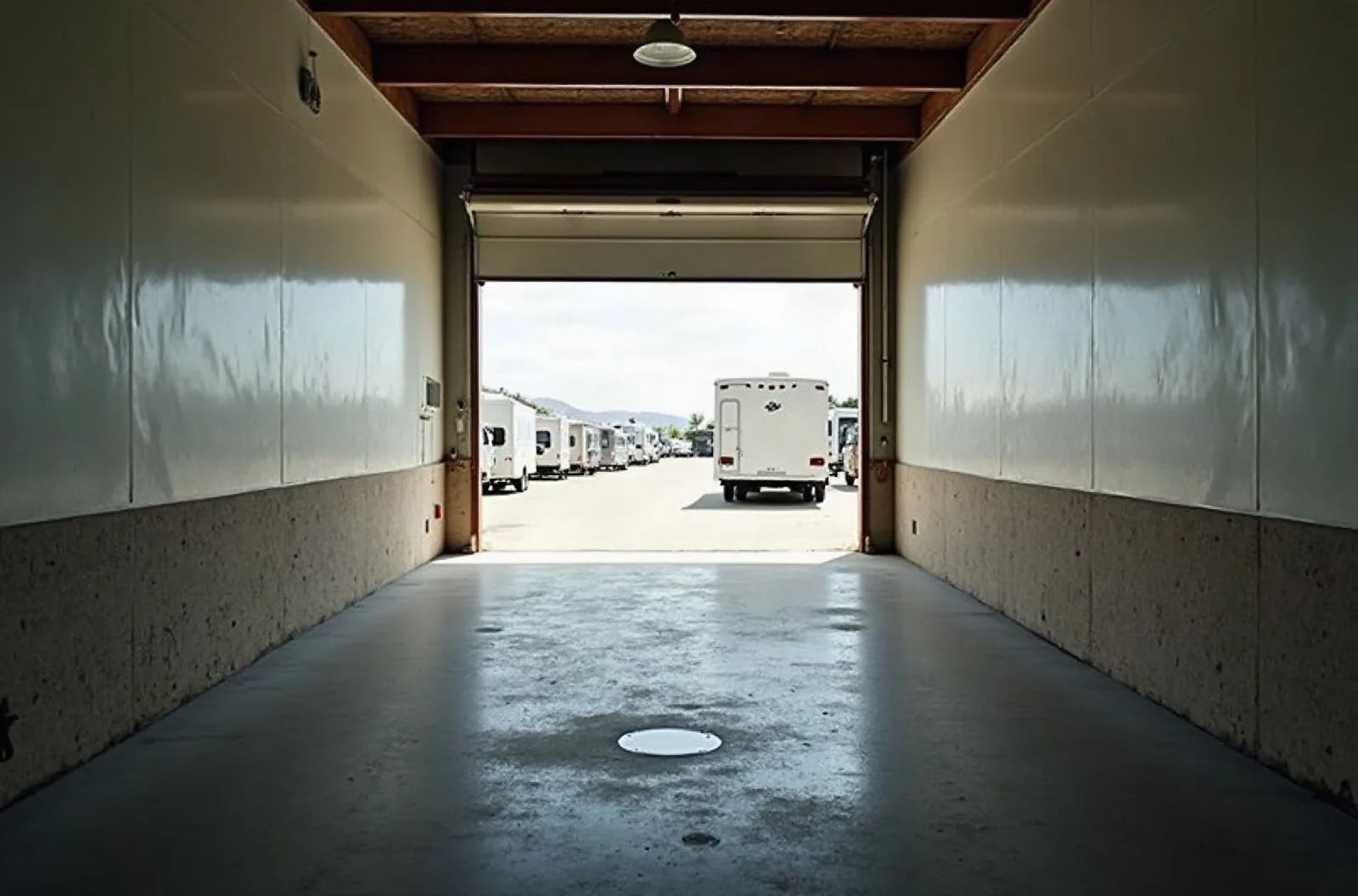
| Indoor / enclosed | $150 to $450 (long 40-foot units higher) | A roll-up door, four walls, and a roof |
| Heated or climate-controlled | $300 to $700+ | Indoor plus temperature and sometimes humidity control |
Lots 15 to 30 minutes outside a metro usually run cheaper, but the savings can evaporate in fuel. I had customers drive all the way from Naples to save $50 a month on a covered space. They’d burn most of that savings in gas getting there.
What pushes rent up: length, width, and clearance
Longer spaces cost more. On the same lot, a 40-foot space rents higher than a 20-foot space, wich means a 40-foot Class A owner pays more than somebody with a teardrop.
Width matters too. A 12 to 14 foot wide space costs more than a 10 footer because backing in is easier and you can open your door without smacking the neighbor’s mirror. My Class C is 24 feet bumper to bumper with the spare carrier on the back. But I still list it as a 25-foot rig when I shop for space, becuase I want room to walk around it.
Clearance will get you if you dont measure right. Most covered canopies have 12 to 16 feet of posted height. My Class C sits about 11 feet to the top of the AC shroud, so a 12-foot beam clears by only a foot. You’ve been warned. I once saw a fifth wheel tear its roof open on a 12-foot canopy because the the owner measured the body but forgot the AC unit. Measure to the highest point and add a few inches.
Metro vs rural: why the same 40 feet costs double in some cities
In Fort Myers, a 30-foot outdoor space went for about $50 to $150 a month in 2023. Drive 25 minutes east into the rural part of Lee County and that same space was $50.
San Diego and the Bay Area can run $150 to $300 just for an outdoor slot, and that’s before any fees. In Orlando, a covered space often goes for $100 to $300, and by September the waitlist for snowbirds is already filling up. I go deeper into that pattern in covered RV storage in Orlando, but the short version: if you’re willing to store 20 minutes outside town, you’ll usually come out ahead.
Rural land is cheap, but check the road in before you commit. I once had to turn a customer away because his 40-foot fifth wheel couldn’t make the sharp turn off the county road into our gravel lot. He’d saved $60 a month going rural, then paid $400 for a tow truck on day one.
I found a helpful video that breaks down the different RV storage options and what to expect.
One-time fees and monthly add-ons: what they don’t put on the sign
The rental rate is the starting point. Every facility I worked at had at least two of these, usually more.
- Admin fee: $15 to $30, charged once at move-in. Not negotiable.
- Lock: many places require you to buy their disc lock, usually $10 to $20. They’ll say it’s for insurance reasons. What it really does is let them cut locks when somebody doesnt pay. Fair enough, but you’re still paying for it.
- Deposit: some sites want one month’s rent up front as a refundable deposit, mostly for indoor units.
- Tenant protection or insurance fee: if you can’t show your own RV policy, the facility will happily add $10 to $30 a month for a plan that’s offen capped at a few thousand dollars. That is not insurance, and it will not replace a rig.
- Prepay discount: pay 6 or 12 months in advance and most places give you a free month or 5 to 10% off. I did this with my own Class C and saved around $80 a year.
- Rent increases: most contracts let the facility raise your rent after the first several months with 30 days’ written notice. I raised rent on existing customers twice in four years, never more than $10 a month. Some corporate-run lots go higher. Read that clause.
Waitlists and the snowbird rush: when price isn’t the problem
If you want covered or indoor space in the Sun Belt between October and December, the price is not your first headache. Finding any open slot is.
In Fort Myers, our covered space waitlist ran about 30 names deep some years by October. Snowbirds from Michigan, Ohio, and Canada would call in August, ask about the rate, and say “I’ll take it” before I finished answering. By November they’d pay anything. That’s how a 30-foot covered space that rented for $100 in May could go for $200 in January and nobody argued.
I wrote a full post on outdoor RV storage vs covered vs indoor that explains the sun damage part, but for price alone, the off-season is when you have use.
Estimate your own monthly number in 10 minutes
- Measure your rig’s lenght and height. Bumper to the tip of the hitch or tongue. Include bike racks and spare tire carriers.
- Pick your minimum storage type. Outdoor if funds are tight, covered if you can swing $120, indoor if you live in hail country or bought a new rig and want to protect it.
- Search listings within 25 miles, not just in town. Note the monthly rate, then add $15 to $30 for admin and $10 for a lock.
- Call the facility and ask three things: “What’s the waitlist?” “What insurance do you require?” “How much notice for a rent increase?”
- Multiply by 12 and add $50. That’s your yearly baseline.
I ran this for a friend with a 30-foot travel trailer in Sarasota. Online rate was $95. First month, all in: $118. Ten months later the rent went to $110, which was still within the typical range for the area. She wasn’t suprised, because she’d planned for exactly that.
Heated and climate-controlled: when the extra $200 a month is worth it
My rule of thumb goes like this. If your RV has a water system and you genuinely can’t winterize it yourself, heated storage might save you from a $600 plumbing repair. If you can winterize, or you live in Florida where a freeze means three nights a year, keep your money.
I did the experiment once. Climate controlled RV storage cost me $385 a month for a 25-foot Class C in Fort Myers the one winter I tried it. My rig had never frozen before, and it didn’t freeze then. I went back to a covered space at $135 a month and spent the difference on diesel.
What I’d tell a friend before they sign a storage contract
Read the rate-change clause out loud. Then check the move-out notice requirement. Some facilities want 30 days, some want 10, and a few in tourist towns want 60 if you’re leaving in April when everybody else is leaving too. Set a calendar reminder the day you move in.
Check your own insurance befor you let them charge you $20 a month for their plan. I keep comprehensive on my Class C all year, even when it’s parked. That runs me about $170 a year, and it usually covers hail, theft, and a tree branch through the roof, but I check my policy each year. The facility’s tenant plan was capped at $3,000, which wouldn’t even replace my dinette.
This weekend, pull up storage listings for your own city. Not the one you wish you lived in. Call two places and ask for the full move-in cost. You’ll know in ten minutes whether that online rate is real.
If you’re still deciding
FAQ
What does RV storage cost per month?
Typical monthly ranges: outdoor $30 to $150 (more in coastal metros), covered $75 to $300, indoor $150 to $450, heated or climate-controlled $300 to $700+. Add a one-time admin fee of $15 to $30 and possibly a required lock. Local rates vary a lot, so call facilities directly.
Is covered RV storage worth the extra money?
Covered storage usually costs $50 to $100 more per month than outdoor, and it's the sweet spot for most rigs, though the difference can be larger in some markets. The roof blocks UV, hail, and most rain, which slows roof sealant failure and paint fade. In sunny climates like Florida or Arizona, a covered space can pay for itself in avoided resealing costs.
Do I need insurance for RV storage?
Most facilities require proof of insurance or charge a tenant protection fee. Your own comprehensive coverage is what protects against theft, vandalism, fire, and storm damage while parked. Many insurers offer a storage or lay-up option that drops collision but keeps comprehensive, which can save money.
Can I prepay RV storage to get a discount?
Many facilities offer a discount for prepaying 6 or 12 months, often a free month or 5 to 10% off. Just make sure you understand the rate-change clause. Prepaying locks in today's rate but may forfeit your money if you move out early, so read the contract.
What size RV storage space do I need?
Measure your RV bumper to bumper, including bike racks, ladders, and a spare tire carrier. Common space lengths are 20, 25, 30, 35, and 40 feet. A 24-foot Class C needs at least a 25-foot space, but a 30-foot space is easier to back into and gives you room to walk around.
Why are RV storage waitlists so long in winter?
Snowbirds from the North head to the Sun Belt from October to April, and they snap up covered and indoor spaces. Waitlists in Southwest Florida can get long by October. If you can, store your RV in the spring or summer when lots empty out, and you'll have better choices and negotiating power.
Is climate controlled RV storage worth the price?
Climate-controlled indoor storage runs $300 to $700 a month, which is alot. It's worth it only if you can't winterize your plumbing and you store in a freezing climate, or if you have a high-value rig and need protection from extreme heat and humidity. For most people, a good cover and winterizing are cheaper.
Find storage near you
Compare covered, indoor and open RV storage in your city, then ask a few places for their current monthly rate.
Browse by state