Rodents vs RVs: sealing gaps and snap traps have the evidence, peppermint and dryer sheets don't
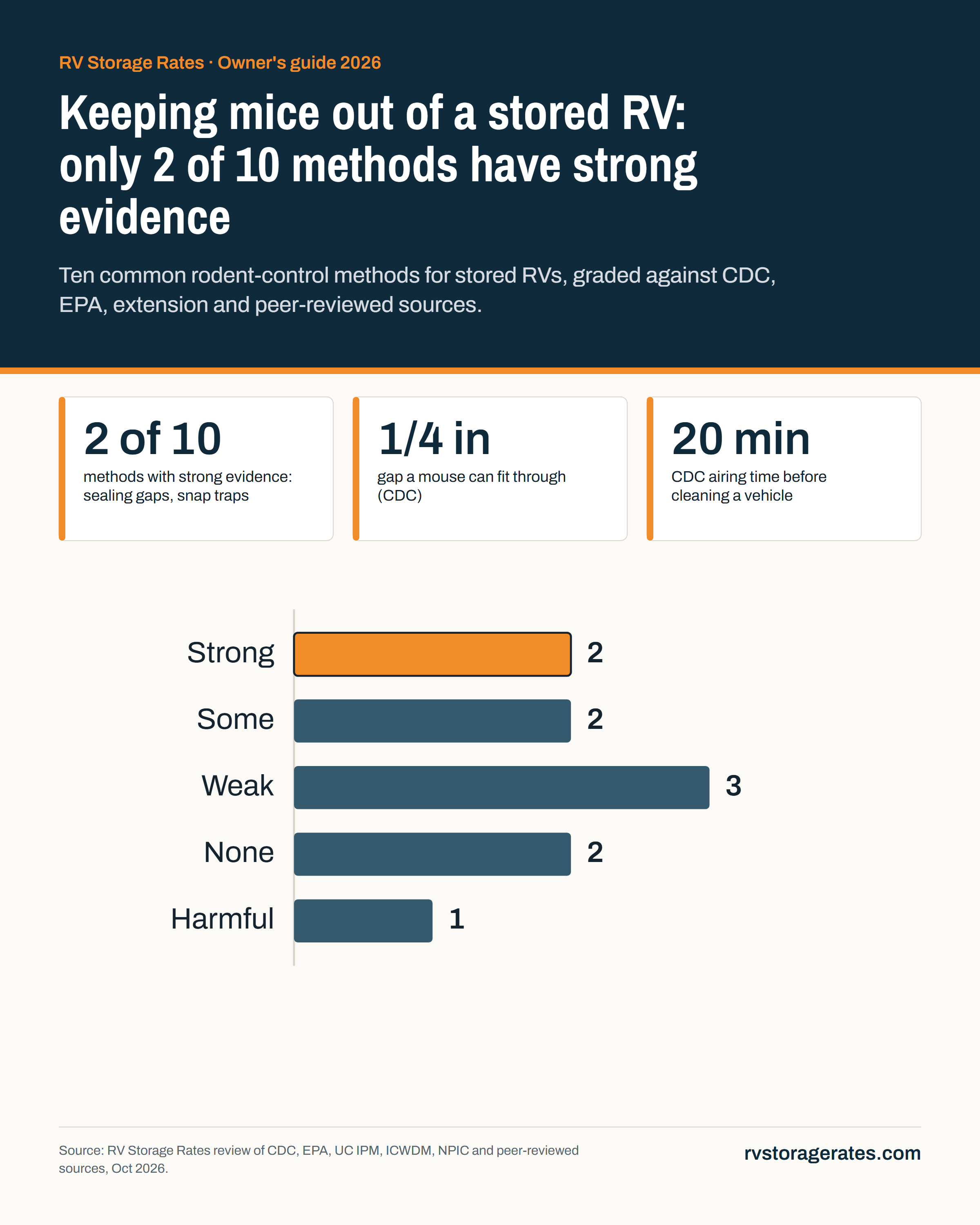
We graded ten popular ways to keep mice out of a stored RV against guidance from the CDC, EPA, university extension services and peer-reviewed research. Only two, sealing entry points with metal and setting snap traps, have strong support. Peppermint oil, ultrasonic boxes and rodent tape rate weak, dryer sheets and lights have no evidence we could find, and mothballs are harmful and illegal to use off-label.
By the RV Storage Rates research desk · Published October 25, 2026
Key findings
- Two methods rate Strong: exclusion and snap traps. UC IPM calls exclusion the most successful and permanent form of house mouse control, and CDC recommends traditional snap traps.
- A quarter inch is enough. CDC says a mouse can fit through a hole the width of a pencil, so every plumbing, wiring and slide-out gap counts.
- Peppermint oil rates Weak. A review of 54 studies found plant compounds worked in the lab but not consistently in the field, and EPA does not review the minimum-risk products sold with it.
- Mothballs rate Harmful. They are pesticides; using them outside the label is unlawful under federal law, and naphthalene vapor causes headaches, nausea and, at high exposure, anemia.
- CDC says rodents are more likely to nest in vehicles used infrequently, and gives vehicle-specific cleanup steps: air the rig out for 20 minutes, use a 1-to-9 bleach solution, never sweep or vacuum droppings.
The scorecard
| Steel wool and metal exclusion | Strong | UC IPM calls exclusion the most successful and permanent form of house mouse control. CDC says to fill small holes with steel wool held in with caulk or spray foam, and notes a mouse fits through a 1/4-inch hole. UC IPM warns steel wool can rust over time. | UC IPM Pest Notes: House Mouse; CDC: Seal up |
| Snap traps | Strong | CDC recommends traditional snap traps and says not to use glue or live traps, which can make rodents urinate. UC IPM says snap traps work well in most situations, set no more than about 10 feet apart, since house mice seldom go more than 30 feet from the nest. | CDC: Trap up; UC IPM Pest Notes: House Mouse |
| Bait stations (rodenticide) | Some | They kill mice, but slowly: UC IPM says baits take several days and mice often die inside the structure, which causes odor. CDC says to use poison only for infestations that persist. EPA allows consumer rodenticides only in ready-to-use bait stations. | UC IPM Pest Notes: House Mouse; CDC: Trap up; EPA: Restrictions on rodenticide products |
| Parking on pavement, away from grass | Some | CDC advises keeping grass and shrubs within 100 feet of a home trimmed and clearing brush and weeds; UC IPM advises thinning plants next to buildings. No study we found compared RVs parked on pavement and on grass, so this applies general habitat advice. | CDC: Seal up; UC IPM Pest Notes: House Mouse |
| Peppermint oil | Weak | A systematic review of 54 publications found plant compounds, including essential oils, showed effects in the lab but inconsistent success across lab, enclosure and field studies. Peppermint oil products can be sold as minimum-risk pesticides, which EPA does not review. | Hansen et al. 2016, J. Chem. Ecol.; EPA: Minimum risk pesticide conditions; 40 CFR 152.25 |
| Ultrasonic repellers | Weak | UC IPM says there is little evidence that sound devices drive established mice out or prevent them, and ultrasound does not penetrate behind objects. ICWDM lists studies finding the devices ineffective, and one 2011 finding of some effect in open areas. | UC IPM Pest Notes: House Mouse; ICWDM: Ultrasound |
| Rodent tape on wiring | Weak | Rodent tape is coated with capsaicin, a pain repellent. ICWDM says pain repellents can protect items an animal isn't meant to eat but must be reapplied. We found no independent test of the tape on vehicle wiring. | ICWDM: Repellents |
| Dryer sheets | None | We found no peer-reviewed or extension test of dryer sheets as a rodent repellent. Even concentrated plant compounds tested by researchers gave inconsistent results. | Hansen et al. 2016, J. Chem. Ecol. |
| Lights under the RV | None | We found no study or extension guidance testing lights under a parked vehicle. UC IPM notes house mice are mostly active at night but are seen in daylight when food is available. | UC IPM Pest Notes: House Mouse |
| Mothballs | Harmful | Mothballs are registered pesticides, and federal law makes it unlawful to use one in a manner inconsistent with its label. ICWDM says repellent effects need concentrations that drive people out too. NPIC lists headaches, nausea and, at high exposure, hemolytic anemia; children and pets may eat them. | 7 U.S.C. 136j; ICWDM: Mothballs; NPIC: Naphthalene fact sheet |
Strong: recommended by a federal agency or extension service as effective. Some: works, with trade-offs, or general guidance not tested on RVs. Weak: lab results or mechanism only. None: no test found. Harmful: health risk or unlawful use. Download this table (CSV)
Why an RV is easy to get into
An RV is a box full of holes. Plumbing and wiring pass through the floor, slide-outs have seals that compress unevenly, and the basement bays, furnace and water heater vents, and generator compartment all open to the outside. CDC's figure is a quarter inch, about the width of a pencil. A stored rig also offers what mice look for: shelter, nesting material in cushions and insulation, and no movement for months. CDC notes that rodents are more likely to nest in vehicles that are used infrequently.
What works, in order
1. Seal the gaps
Exclusion is the only method in our list that keeps mice out instead of dealing with them once they're in. Crawl under the rig with a flashlight and look up for daylight around pipes, cables and the frame. CDC's method is steel wool in small holes, held in place with caulk or spray foam, and metal, hardware cloth or sheeting for larger openings. UC IPM says plastic screening, rubber, vinyl, expanding foam and wood are ineffective on their own because mice gnaw through them, and that steel wool may rust over time.
2. Trap what gets in
Snap traps tell you whether mice are getting in and remove the ones that do. Set them along walls, in cabinets and in the basement bays, close together, since house mice seldom travel more than 30 feet from the nest. CDC advises against glue and live traps. Check them on every visit.
3. Bait stations, with caution
Rodenticide stations kill mice, but UC IPM notes the mice often die inside the structure, and in an RV that can mean a dead mouse inside a wall or duct. CDC reserves poison for infestations that persist. If you use them, keep stations outside the living space, follow the label, and remember pets and wildlife.
4. Pick the right spot
Tall grass and brush give mice cover right up to the tires. CDC's household advice is to keep vegetation trimmed and brush cleared. A paved or gravel lot with mowed edges, or an indoor RV storage building, removes much of that cover. No study we found compared rodent problems by lot surface, so treat this as sensible habitat advice rather than a tested result.
Step-by-step storage checklist
- Empty every food item, including sealed packages, pet food, spices and toiletries with food scents. Prop the fridge open after cleaning it.
- Clean crumbs from the floor, under the dinette and inside drawers.
- Inspect from below with a flashlight for gaps around pipes, cables, the furnace and water heater, and the slide-out seals.
- Seal gaps of 1/4 inch or more with steel wool or metal mesh and caulk or foam; use hardware cloth or metal for larger openings.
- Cover exterior vents that can be closed while stored, following the appliance manual, and remove covers before use.
- Set snap traps inside cabinets, in the basement bays and in the engine compartment if motorized.
- Remove nesting material such as paper towels, rags and loose bedding, or store them in sealed bins.
- Park on pavement or gravel away from tall grass, brush and woodpiles where you can; compare outdoor RV storage and covered RV storage lots by surface.
- Skip mothballs, dryer sheets and ultrasonic boxes. The first is harmful and the others lack evidence.
- Check every few weeks, reset traps, and look for droppings and gnawed wire insulation.
If you find droppings: CDC hantavirus cleanup steps
CDC says that when fresh urine, droppings or nesting material from an infected rodent are stirred up, hantavirus can get into the air, and people are infected by breathing it. Its cleanup steps are built to avoid that. For vehicles, CDC says to air the vehicle out by opening the hood, doors and trunk for 20 minutes before inspecting. For cabins, sheds and other closed spaces, it says to open doors and windows for 30 minutes and leave during that time.
- Ventilate first, 20 minutes for a vehicle or 30 minutes for a closed building, and stay out while it airs.
- Wear rubber or plastic gloves, plus a long-sleeved shirt for a vehicle.
- Do not sweep or vacuum urine, droppings or nests. CDC says this can put virus particles in the air.
- Spray until very wet with an EPA-registered disinfectant or a fresh bleach solution of 1.5 cups of bleach per gallon of water (1 part bleach to 9 parts water), and let it soak 5 minutes or as the label says.
- Wipe up with paper towels, then double-bag droppings, nests and dead mice and put them in a covered trash can.
- Disconnect the battery before inspecting a motorhome's engine compartment, and reconnect it when the area is dry.
- Replace the air filter if nesting material is in the air intake.
- Wash gloved hands, then bare hands, with soap and warm water. For heavy infestations CDC recommends coveralls, goggles and a respirator with a HEPA filter.
The infographic
Free to use with a link. Publish the graphic or the numbers anywhere, as long as you credit RV Storage Rates with a link to this page.
How we did this
- We graded ten methods that RV owners commonly use or recommend, using CDC rodent-control guidance, EPA rodenticide and pesticide rules, University of California Statewide IPM Program Pest Notes, the Internet Center for Wildlife Damage Management, the National Pesticide Information Center, and a peer-reviewed systematic review. Sources were read October 24 and 25, 2026.
- Strong means a federal agency or extension service recommends the method as effective. Some means it works with real trade-offs, or rests on general guidance not tested on vehicles. Weak means lab results, a plausible mechanism or mixed findings, but no reliable field support. None means we found no test. Harmful means a documented health risk or unlawful use.
- Most of the evidence is about mice in buildings, not RVs. We found no controlled study of rodent control in stored RVs, so the grades describe how well each method is supported in general.
- This guide does not use our review data. Rodent complaints in storage-lot reviews are covered in a separate study.
Sources
- UC Statewide IPM Program, Pest Notes: House Mouse, accessed October 25, 2026
- CDC, Seal up to prevent rodent infestations, accessed October 25, 2026
- CDC, Trap up to control rodents, accessed October 25, 2026
- CDC, Clean up after rodents, accessed October 25, 2026
- CDC, Hantavirus prevention, accessed October 25, 2026
- EPA, Restrictions on rodenticide products, accessed October 25, 2026
- EPA, Conditions for minimum risk pesticides, accessed October 25, 2026
- 40 CFR 152.25, exemptions (minimum-risk active ingredients incl. peppermint oil), accessed October 25, 2026
- Hansen, Stolter, Imholt and Jacob (2016), Plant Secondary Metabolites as Rodent Repellents: a Systematic Review, Journal of Chemical Ecology 42:970-983, accessed October 25, 2026
- ICWDM, Ultrasound as a repellent, accessed October 25, 2026
- ICWDM, Repellents, accessed October 25, 2026
- ICWDM, Mothballs as a wildlife repellent, accessed October 25, 2026
- National Pesticide Information Center, Naphthalene general fact sheet, accessed October 25, 2026
- 7 U.S.C. 136j(a)(2)(G), FIFRA unlawful acts, accessed October 25, 2026
Cite this: RV Storage Rates, "Rodents vs RVs: sealing gaps and snap traps have the evidence, peppermint and dryer sheets don't," October 25, 2026, https://rvstoragerates.com/keep-mice-out-of-rv-in-storage/
Spotted an error or have newer data? Tell us and we'll check it and update the page.
Questions people ask
What is the best way to keep mice out of a stored RV?
Seal the entry points and set snap traps. UC IPM calls exclusion the most successful and permanent form of house mouse control, and CDC recommends steel wool with caulk or foam for small holes and snap traps for mice that get in. Remove all food and check traps every few weeks.
Does peppermint oil keep mice out of an RV?
The evidence is weak. A systematic review of 54 studies found plant compounds such as essential oils worked in laboratory tests but gave inconsistent results in enclosure and field studies. Peppermint products are sold as minimum-risk pesticides, which EPA does not review.
Do dryer sheets repel mice?
We found no peer-reviewed or extension test showing that dryer sheets repel mice. Researchers have tested concentrated plant compounds with inconsistent results, so a scented sheet is unlikely to do better. Spend the effort on sealing gaps instead.
Can I put mothballs in my RV?
Don't. Mothballs are registered pesticides, and federal law makes using a pesticide in a manner inconsistent with its label unlawful. Naphthalene vapor can cause headaches, nausea and, at high exposure, hemolytic anemia, and small children and pets may eat them.
How do I safely clean mouse droppings out of my RV?
CDC says to air out a vehicle for 20 minutes, wear gloves, and never sweep or vacuum droppings. Soak them with disinfectant or a 1-to-9 bleach solution for 5 minutes, wipe up with paper towels, and double-bag the waste. Replace the air filter if mice nested in the intake.