Stored, not driven: 10 states have a formal way to pause an RV's registration or insurance
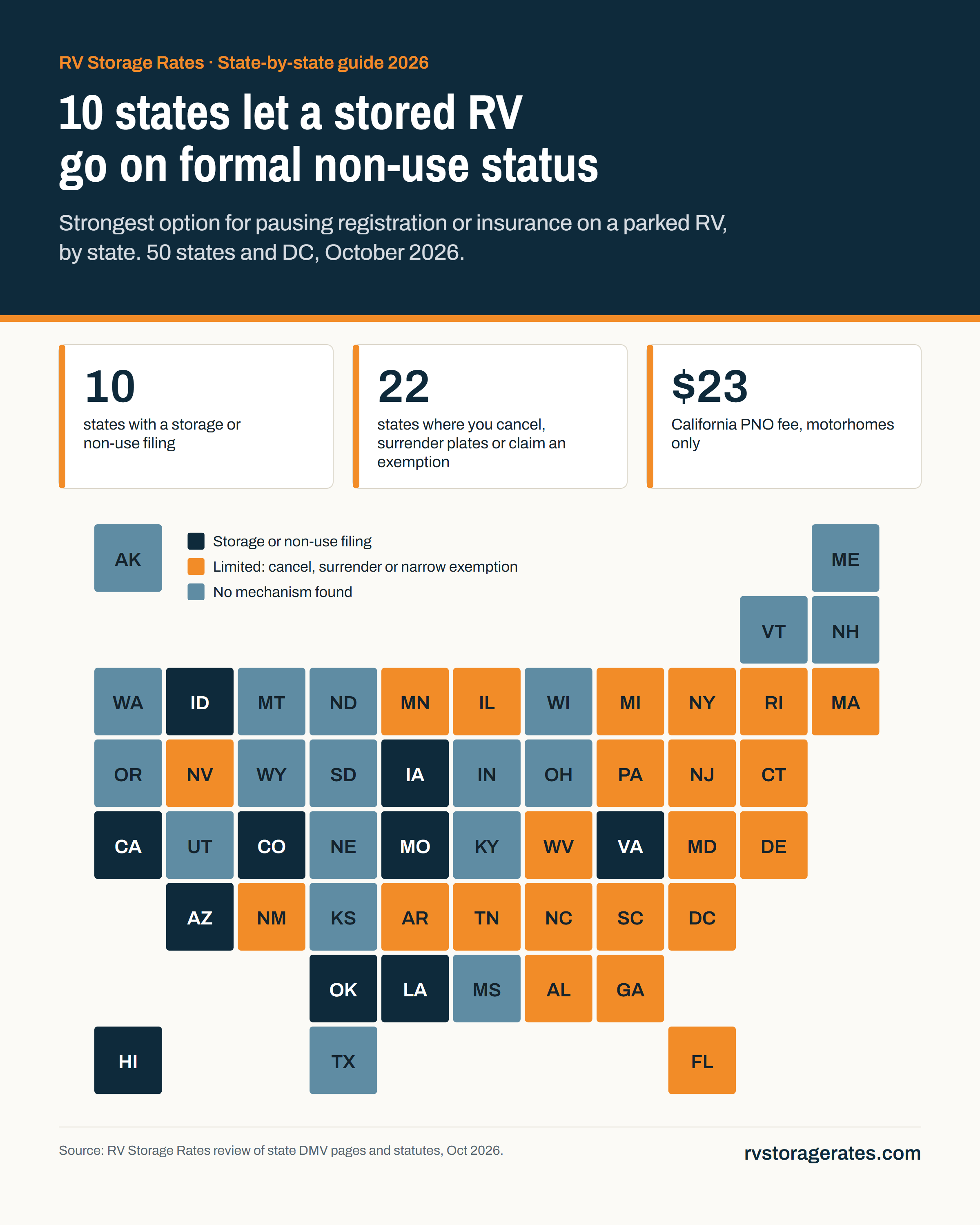
We read DMV pages and vehicle statutes for all 50 states and DC to see whether an RV that sits in storage all season can come off the road on paper. 10 states have a formal storage or non-use filing, 22 more let you stop paying for coverage only by cancelling the registration, surrendering plates or using a narrow exemption, and 19 have no mechanism we could find.
By the RV Storage Rates research desk · Published October 25, 2026
Key findings
- 10 states have a formal storage or non-use filing: Arizona, California, Colorado, Hawaii, Idaho, Iowa, Louisiana, Missouri, Oklahoma and Virginia.
- California's PNO costs $23 a year but does not cover travel trailers. The DMV lists trailer coaches and park trailers as ineligible, so the cheapest pause in the country is for motorhomes, not towables.
- In 22 states the path is cancel first, then drop coverage. Maryland, North Carolina, Florida, DC, Pennsylvania, New York and South Carolina all warn that cancelling insurance before the plates come off triggers fines or a suspension.
- Oklahoma and West Virginia write non-use into the insurance rules. Oklahoma's Form 797 swaps proof of insurance for a sworn non-use affidavit, and West Virginia treats an RV stored part of the year as a seasonal vehicle that needs coverage only while in use.
- 19 states have no storage mechanism we could find, including Kentucky, which revokes a registration 14 days after coverage lapses unless proof of insurance is shown.
The map
Each state is coloured by the strongest option an owner has for an RV that will not move for months. A formal filing means the DMV keeps the vehicle on its books in a stored or non-use status. Limited means you can stop coverage, but only by cancelling the registration, turning in plates, or relying on a narrow statutory exemption.
State-by-state table
Status covers motorhomes unless the row says otherwise. Many states treat towable trailers differently, and some do not require insurance on a trailer at all, so check the source link for your rig type before you cancel anything.
| Alabama | Limited | Stored, inoperable or unused exemption (registration revocation) | None; reinstatement fee waived if accepted | Yes, surrender to local licensing official | Yes, if the vehicle was not operated and you claim the exemption with evidence of non-use (Ala. Code 32-7A-11) | Alabama Dept. of Revenue FAQ |
| Alaska | No | None found | Not confirmed | Not confirmed | Owners of a vehicle subject to registration must carry liability coverage (AS 28.22.101, per DMV); no storage exemption found | Alaska Statutes (AS 28.22) |
| Arizona | Yes | De-insurance (AZ MVD Now) | Not confirmed | No | Yes. A de-insured vehicle is not suspended for lack of insurance unless it is driven on Arizona roads | ADOT: What is de-insurance? |
| Arkansas | Limited | Affidavit of Non-Use (Form 10-300) for an expired registration | Late-registration penalties not due for the months the vehicle was not operated | Not confirmed | No storage exemption stated; DFA says you must maintain liability insurance on your vehicle | Arkansas DFA: Vehicle tag renewal |
| California | Yes | Planned Non-Operation (PNO); not available for trailer coaches or park trailers | $23 | No | Yes for a PNO vehicle, which may not be driven, towed, stored or parked on public roads | California DMV: Planned Nonoperation Filing |
| Colorado | Yes | Affidavit of Non-Use (DR 2303) | None stated | No | Yes, the affidavit covers vehicles that will not be operated; registration and late fees still apply | Colorado DMV: Registration requirements |
| Connecticut | Limited | Registration cancellation | None stated | No; plates can be discarded | Cancel the registration first; a lapse while registered can lead to suspension | CT DMV: Cancel registration and plates |
| Delaware | Limited | None; return tags | None | Yes, surrender tags | Lapse penalty of $100, then $5 a day, runs until insurance is replaced or tags are surrendered (21 Del. C. 2118) | Delaware Code, Title 21, ch. 21 |
| District of Columbia | Limited | Tag surrender | None stated | Yes, surrender or cancel tags online | Only after the tag surrender receipt; cancelling insurance first triggers a lapse fee | DC DMV: Tag surrender |
| Florida | Limited | License plate surrender | None stated | Yes | Only after the plate is surrendered; a vehicle not being driven must surrender tag and registration when insurance is cancelled | FLHSMV: Florida insurance requirements |
| Georgia | Limited | Voluntary registration cancellation (MV-18J) | None stated | Not confirmed | Cancel registration before or when you drop coverage to avoid lapse fees; proof required for stored vehicles | Georgia DOR: Cancellation and reinstatement of registration |
| Hawaii | Yes | Stored vehicle exemption (HRS 249-5.5) | Not confirmed | Yes, surrender registration, plates and emblem | Not confirmed | Hawaii State Legislature (HRS ch. 249) |
| Idaho | Yes | Affidavit of Non-Use of Registered Motor Vehicle (ITD 3119) | None stated | No | Yes, if you notify ITD before suspension that the vehicle is stored or not operated (Idaho Code 49-1229, 49-1234) | Idaho Code 49-1229 |
| Illinois | Limited | None; statutory exemption | Not confirmed | Not confirmed | Inoperable or stored vehicles that are not operated are exempt from mandatory insurance (625 ILCS 5/7-601(b)) | 625 ILCS 5/7-601 |
| Indiana | No | None found | Not confirmed | Not confirmed | Law bars operating a vehicle without financial responsibility (IC 9-25-4); no storage filing found | Indiana BMV: Proof of financial responsibility |
| Iowa | Yes | Vehicle storage (761 IAC 400.33) | No fee to store; $5 for replacement plates on removal | Yes, surrender plates to county treasurer | Iowa requires coverage to drive on the highways (Iowa Code 321.20B) | Iowa Admin. Code 761-400.33 |
| Kansas | No | None found | Not confirmed | Not confirmed | Every owner must insure every motor vehicle owned, with listed exceptions; no storage exception found (K.S.A. 40-3104) | Kansas Legislature (K.S.A. 40-3104) |
| Kentucky | No | None found | Not confirmed | Not confirmed | No storage exemption found. Registration is revoked unless proof of insurance is shown within 14 days after coverage becomes invalid (KRS 186A.040(5)) | KRS 186A.040 |
| Louisiana | Yes | Statement of Non-Use | None stated | No, plate can stay on the vehicle | Yes, if the statement is filed before the policy ends | Louisiana OMV: Statement of Non-Use |
| Maine | No | None (stored-vehicle rule repealed 2007) | Not confirmed | Not confirmed | Owners of vehicles registered in Maine must maintain coverage (29-A M.R.S. 1601) | 29-A M.R.S. 1601 |
| Maryland | Limited | None; return plates | None | Yes, return plates before cancelling | Only after plates are returned; otherwise a compulsory insurance violation | Maryland MVA: Returning license plates |
| Massachusetts | Limited | Registration cancellation | None | No | Cancel the registration; the RMV revokes registrations after an insurance cancellation if no action is taken | Mass.gov: Cancel your vehicle registration |
| Michigan | Limited | Late-fee waiver with storage insurance | Waives the $10 late fee | No | Yes. No-fault security is only required while the vehicle is driven or moved on a highway (MCL 500.3101) | MCL 257.801 |
| Minnesota | Limited | None; statutory rule | Not confirmed | Not confirmed | Owners must keep coverage during the period in which operation or use is contemplated (Minn. Stat. 65B.48) | Minn. Stat. 65B.48 |
| Mississippi | No | None found | Not confirmed | Not confirmed | Coverage required to operate (Miss. Code 63-15-4); stored-vehicle rule not confirmed | Mississippi Legislature |
| Missouri | Yes | Voluntary suspension of registration (inoperable or stored vehicle) | No reinstatement fee | Not confirmed | Yes for an inoperable or stored vehicle; driving it during the claimed period is a class B misdemeanor (RSMo 303.025) | RSMo 303.025 |
| Montana | No | None found | Not confirmed | Not confirmed | Owners of a vehicle registered and operated in Montana must continuously insure it (MCA 61-6-301) | MCA 61-6-301 |
| Nebraska | No | None found | Not confirmed | Not confirmed | The owner's insurance offense applies to a vehicle operated or towed on a public highway (Neb. Rev. Stat. 60-3,167) | Neb. Rev. Stat. 60-3,167 |
| Nevada | Limited | Dormant vehicle registration cancellation | None stated | Present plates for sticker removal; may keep them up to 1 year | Only after cancelling the registration, on or before the policy ends (NRS 485.320) | NRS chapter 485 |
| New Hampshire | No | None found | Not confirmed | Not confirmed | No general insurance mandate; financial responsibility applies after a crash (RSA 264) | RSA 264:20 |
| New Jersey | Limited | None; surrender registration and plates | None stated | Yes, surrender registration and plates to MVC | Registered owners must keep liability coverage; if you no longer use the vehicle, surrender registration and plates and send MVC the plate receipt | NJ MVC: Uninsured motorist enforcement FAQ |
| New Mexico | Limited | Affidavit of Non-Use/Out-of-State Insurance (MVD-11268) | Not confirmed | Not confirmed | MVD describes the affidavit mainly for owners insured out of state; use for in-state storage not confirmed | NM MVD: Insurance |
| New York | Limited | Temporary surrender of plates and registration (store plates for a season) | None to surrender; up to $25 for new standard plates on reinstatement | Yes; standard plates are destroyed, personalized plates are stored | Yes, after you surrender plates and registration; the DMV says you can then cancel liability insurance for the winter | NY DMV: Temporary surrender of plates (store plates for a season) |
| North Carolina | Limited | None; turn in plate | None stated | Yes, before cancelling insurance | Registered vehicles need continuous coverage (G.S. 20-309); cancel only after the plate is surrendered | NCDMV: Insurance requirements |
| North Dakota | No | None found | Not confirmed | Not confirmed | Law bars driving, or letting a vehicle be driven, without liability coverage (N.D.C.C. 39-08-20) | N.D.C.C. ch. 39-08 |
| Ohio | No | None found | Not confirmed | Not confirmed | Proof of financial responsibility must be kept throughout the registration period for a vehicle that is operated (ORC 4509.101) | ORC 4509.101 |
| Oklahoma | Yes | Affidavit of Nonuse in Lieu of Liability Insurance (Form 797) | None stated; notarized affidavit filed with your registration | No | Yes, for the dates sworn on the affidavit that the vehicle will not be driven on public streets or highways (exempt from 47 O.S. 7-601 et seq.) | Service Oklahoma Form 797: Affidavit of Nonuse in Lieu of Liability Insurance |
| Oregon | No | None found | Not confirmed | Not confirmed | The offense is driving uninsured on a highway or premises open to the public (ORS 806.010) | ORS chapter 806 |
| Pennsylvania | Limited | None; plate surrender | None | Yes, surrender the plate | If the plate is surrendered immediately, nothing happens; otherwise a lapse brings a 3-month registration suspension | PennDOT: Penalties for cancelling insurance |
| Rhode Island | Limited | Registration cancellation (online, drop box or mail) | None stated | No; after online cancellation plates may be destroyed or recycled | Registered vehicles must keep liability insurance for the whole registration (RIGL 31-47); cancel the registration to avoid insurance revocation fines | RI DMV: Cancel plates / registration |
| South Carolina | Limited | None; turn in plate and registration | None stated; up to $400 to reinstate after a lapse | Yes, to an SCDMV branch before cancelling insurance | Only after the plate and registration are turned in; otherwise driving privilege, plates and registration are suspended | SCDMV: Facts about driving uninsured |
| South Dakota | No | None found | Not confirmed | Not confirmed | Owners must at all times maintain financial responsibility on the vehicle (SDCL 32-35-113) | SDCL 32-35-113 |
| Tennessee | Limited | Stored or inoperable exemption, certified on the DriveInsuredTN questionnaire | None stated; $25 coverage failure fee if a verification notice goes unanswered for 30 days | Not confirmed | A stored or inoperable vehicle may be exempt from the financial responsibility requirement; certify its status when you receive a verification notice | TN Dept. of Revenue: Proof of exemption from financial responsibility (DIFD-10) |
| Texas | No | None found | Not confirmed | Not confirmed | A person may not operate a motor vehicle without financial responsibility (Transp. Code 601.051) | Tex. Transp. Code 601.051 (via public.law) |
| Utah | No | None found | Not confirmed | Not confirmed | No. Coverage must be kept throughout the registration period (Utah Code 31A-22-302, per DMV) | Utah DMV: Insurance requirements |
| Vermont | No | None found | Not confirmed | Not confirmed | Owners may not operate or permit operation on highways without a liability policy (23 V.S.A. 800) | 23 V.S.A. 800 |
| Virginia | Yes | License plate deactivation | Not confirmed | No, plates deactivated (or surrender them) | If coverage ends you must reinsure, deactivate the plates or surrender them; otherwise a $600 non-compliance fee | Virginia DMV: Insurance requirements |
| Washington | No | None found | Not confirmed | Not confirmed | No person may operate a vehicle subject to registration without insurance (RCW 46.30.020) | RCW 46.30.020 |
| West Virginia | Limited | Periodic use or seasonal vehicle rule (covers RVs) | None stated | May keep plates under DMV rules | Yes for a seasonal RV: coverage only for the part of the year it is in use (W. Va. Code 17D-2A-3) | W. Va. Code 17D-2A-3 |
| Wisconsin | No | None found | Not confirmed | Not confirmed | No person may operate on a highway without a liability policy in effect (Wis. Stat. 344.62) | Wis. Stat. 344.62 |
| Wyoming | No | None found | Not confirmed | Not confirmed | Owners may not operate or permit operation without a liability policy (W.S. 31-4-103) | Wyoming Statutes, Title 31 |
Not confirmed in a cell means we could not read that detail on an official page during this review. It does not mean the state has no option. Fees are as published on the source page in October 2026. Download this table (CSV)
What the three approaches look like
1. A formal storage or non-use filing
California's Planned Non-Operation is the best known. You file before or soon after the registration expires, pay $23 instead of the full renewal, and the vehicle may not be driven, towed, stored or parked on a public road for the year. Louisiana's Statement of Non-Use and Arizona's de-insurance work on the insurance side: the state stops sending lapse notices and you keep the plate. Iowa and Hawaii take the plates back and hold the registration in a storage status. Missouri lets owners of stored vehicles voluntarily suspend the registration with no reinstatement fee, and Oklahoma accepts a notarized non-use affidavit in place of proof of insurance when you register.
2. Cancel or surrender first
Most states with insurance databases match every registered vehicle against an active policy. If the policy drops while the plate is still active, the system flags a lapse. That is why Maryland, North Carolina, Florida, DC, Delaware, Pennsylvania, New York and South Carolina tell owners to return the plates before the policy ends. Pennsylvania puts it plainly: if you surrender the plate right away, nothing happens. New York calls its version a temporary surrender to store plates for a season. Tennessee takes a different route: if a verification notice arrives for a stored or inoperable vehicle, you certify that status online.
3. No mechanism
In states like Texas, Washington, Oregon and Wisconsin the insurance law is written around operating the vehicle, and we found no storage filing. Whether an uninsured but registered RV sitting in a storage lot breaks the law there is a question for the DMV, not a guess we will make for you. Utah and South Dakota are explicit that coverage must be kept while the vehicle is registered, and Kentucky revokes the registration 14 days after coverage lapses unless proof of insurance is shown.
Storage insurance and comp-only coverage
Dropping liability is not the same as dropping all coverage. Many insurers offer a reduced policy for a parked vehicle, often called storage insurance, lay-up coverage or comp-only coverage (comp is the other-than-collision part of an auto or RV policy). In general terms it removes or suspends the liability and collision parts of a policy and keeps comp, which is the part that pays for theft, fire, hail, wind, falling objects, vandalism and animal damage, including rodents chewing wiring, depending on the policy wording.
- It does not let you drive. Liability is what makes a vehicle legal on the road. A comp-only RV should not leave the lot until full coverage is back.
- It may not satisfy the state. In a state that checks every registered plate against a liability policy, a comp-only policy can still trigger a lapse notice. Pair it with the state's storage filing or plate surrender.
- Lenders usually require it. If the RV is financed, the loan contract almost always requires physical damage coverage the whole time.
- Michigan recognizes it by name. Michigan waives the late registration fee for owners who show proof of storage insurance for the months the vehicle sat.
- Read the exclusions. Some policies exclude damage from vermin or gradual deterioration. Our guide to keeping mice out of a stored RV covers the prevention side.
What it means for you
- Decide first whether the RV will move at all. Every pause option assumes zero road use. Even the drive to the storage lot needs active coverage and registration, or a one-day moving permit in states that offer one, such as California.
- File before the policy ends. Louisiana requires the non-use statement before the policy terminates, and the cancel-first states penalize the reverse order.
- Keep comp coverage. Theft, hail and rodent damage do not take the winter off. A storage lot with good security lowers that risk; compare indoor RV storage and covered RV storage if your rig sits for months.
- Keep the receipt. Every state that takes plates or files a non-use statement gives you a receipt. Insurers and DMVs both ask for it.
- Plan the restart. Reinstate insurance first, then registration, then drive. In Arizona the registration is not valid until the insurer reports the new policy, and Missouri reinstates a suspended registration on proof of insurance.
The infographic
Free to use with a link. Publish the graphic or the numbers anywhere, as long as you credit RV Storage Rates with a link to this page.
How we did this
- We compiled the table between October 24 and 25, 2026, from state DMV, DOR and MVA pages, state forms and state statutes on official legislature websites. Secondary sources were used only to find the primary page.
- Formal filing means the state offers a named storage, non-use, de-insurance or plate-deactivation status for a vehicle that stays titled and on the record. Limited means the only route we found was cancelling the registration, surrendering plates, or a statutory exemption that needs no filing. No means we found neither.
- Every state now has a status from an official source. Eight states (Arkansas, Kentucky, New Jersey, New York, Oklahoma, Rhode Island, South Carolina and Tennessee) were first marked Not confirmed and were filled on October 25, 2026, from DMV pages, a Service Oklahoma form, a Tennessee Department of Revenue FAQ and the Kentucky Revised Statutes. Individual cells such as a fee or plate rule still say Not confirmed or None stated where the source page did not print them.
- The status column describes motorhomes. Trailer rules differ: California excludes trailer coaches from PNO, and several states do not require liability insurance on a trailer. We did not survey trailer insurance rules state by state.
- We name no insurers. The insurance section describes coverage types in general terms only.
Not legal advice. Laws and agency rules change. Each row links the source we read and the date we checked it; confirm with the agency or an attorney before you rely on it.
Sources
- California DMV, Planned Nonoperation Filing, accessed October 25, 2026
- California DMV fee schedule FFVR 34 (PNO fee $23), accessed October 25, 2026
- Louisiana OMV, Statement of Non-Use, accessed October 25, 2026
- ADOT, What is de-insurance?, accessed October 25, 2026
- Iowa Administrative Code 761-400.33, Storage of vehicles, accessed October 25, 2026
- Revised Statutes of Missouri 303.025, accessed October 25, 2026
- West Virginia Code 17D-2A-3, accessed October 25, 2026
- Michigan Compiled Laws 257.801 and 500.3101, accessed October 25, 2026
- PennDOT, What can occur if I cancel my liability insurance?, accessed October 25, 2026
- Virginia DMV, Insurance requirements, accessed October 25, 2026
- Maryland MVA, Returning license plates, accessed October 25, 2026
- NCDMV, Insurance requirements, accessed October 25, 2026
- Arkansas DFA: Vehicle tag renewal, accessed October 25, 2026
- KRS 186A.040, accessed October 25, 2026
- NJ MVC: Uninsured motorist enforcement FAQ, accessed October 25, 2026
- NY DMV: Temporary surrender of plates (store plates for a season), accessed October 25, 2026
- Service Oklahoma Form 797: Affidavit of Nonuse in Lieu of Liability Insurance, accessed October 25, 2026
- RI DMV: Cancel plates / registration, accessed October 25, 2026
- SCDMV: Facts about driving uninsured, accessed October 25, 2026
- TN Dept. of Revenue: Proof of exemption from financial responsibility (DIFD-10), accessed October 25, 2026
- Each state's row source, listed in the table, accessed October 25, 2026
Cite this: RV Storage Rates, "Stored, not driven: 10 states have a formal way to pause an RV's registration or insurance," October 25, 2026, https://rvstoragerates.com/rv-registration-storage-pause-by-state/
Spotted an error or have newer data? Tell us and we'll check it and update the page.
Questions people ask
Can I put my RV on non-op status?
In 10 states there is a formal filing for that: Arizona, California, Colorado, Hawaii, Idaho, Iowa, Louisiana, Missouri, Oklahoma and Virginia. Names differ, from California's Planned Non-Operation to Oklahoma's Affidavit of Nonuse in Lieu of Liability Insurance. In most other states the only route is cancelling the registration or turning in the plates.
Can I file PNO on a travel trailer in California?
No. The California DMV lists trailer coaches and park trailers among the vehicles that cannot be placed in Planned Non-Operation status. Motorhomes can be. The PNO fee on the DMV's fee schedule is $23, and the vehicle may not be driven, towed, stored or parked on a public road during the year.
Do I need insurance on an RV that sits in storage?
It depends on the state. Some tie the requirement to driving, some to registration. In states like Maryland, New York, South Carolina and Florida you must surrender the plates before cancelling liability or face penalties. Even where liability can stop, owners can keep other-than-collision coverage for theft, hail and rodent damage.
What is storage insurance for an RV?
Storage, lay-up or comp-only insurance is a reduced policy for a vehicle that is not being driven. It generally keeps the other-than-collision part that covers theft, fire, weather and animal damage and drops liability and collision. It does not make the RV legal to drive, so restore full coverage before it leaves the lot.
What happens if I cancel insurance without turning in my plates?
In states with insurance verification, the DMV sees an active plate with no policy and treats it as a lapse. Pennsylvania suspends the registration for three months, Delaware charges $100 and then $5 a day after 30 days, and Virginia charges a $600 non-compliance fee. Surrender or deactivate plates first.