RV and Boat Storage Yards: Sharing Lots With Boats and Toy Haulers
By Jenna Halvorsen · October 29, 2026
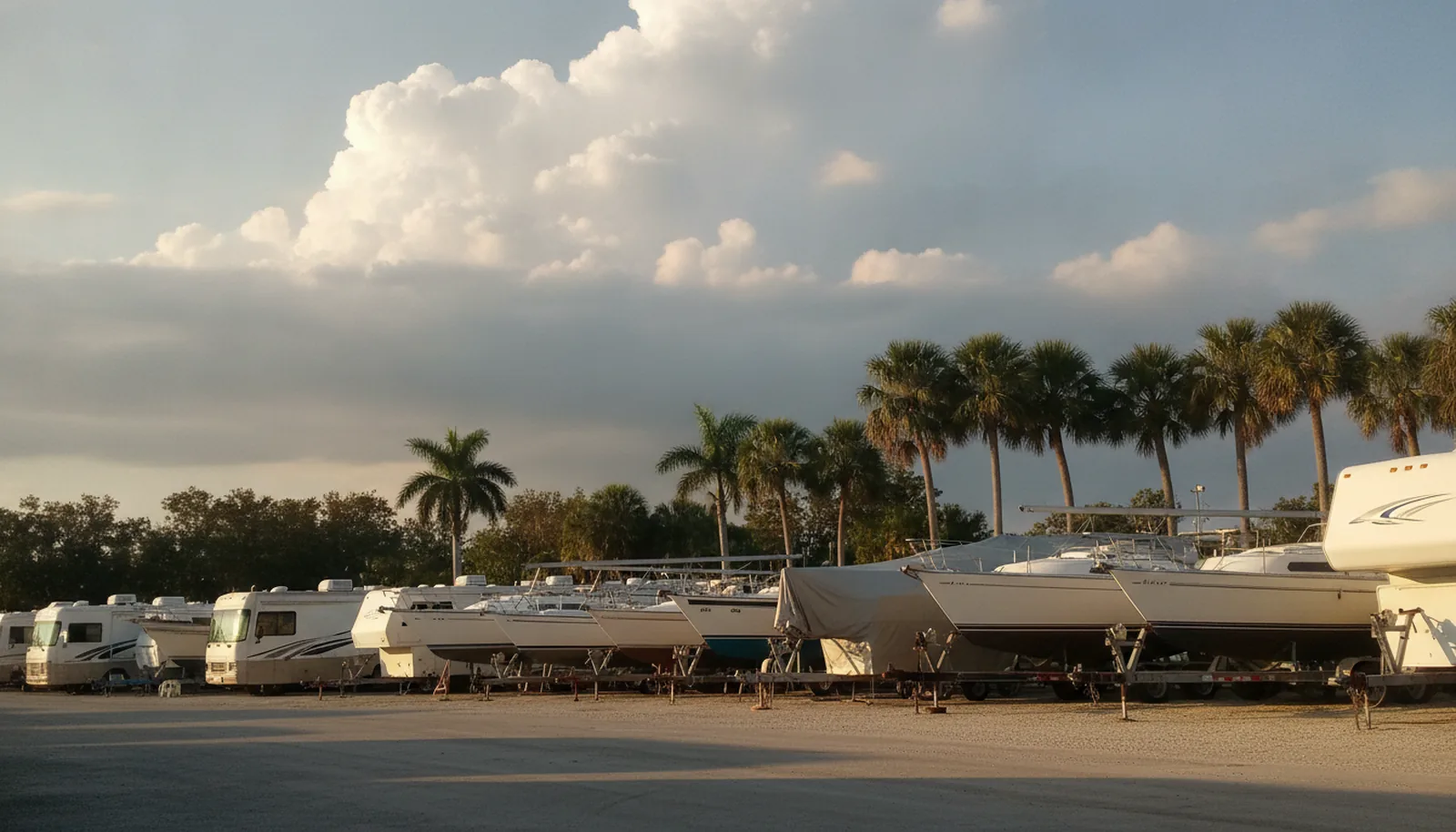
Last August I watched a line of pickups snake out onto the highway from our front office in Southwest Florida, and it hit me again how many times people ask about RV storage across Florida. Guy waiting to pay his bill said, “Boat traffic’s worse than church traffic.” He wasn’t wrong. On a good Saturday, the launch rush starts at 6:40 a.m., and the gate keypad sounds like a pinball machine.
I ran that office for four years, right next to the RV storage in Fort Myers. I’ve seen what happens when somebody sticks a 24-foot Class C between two center console boats on trailers. If you’re comparing RV storage in Fort Myers, most lots around here mix everything: boats, RVs, toy haulers, cargo trailers, all in the same yard.
Why combined RV and boat storage yards are so common in coastal cities
Land near the water costs too much to let a business sit half empty. A facility with 300 spaces can’t turn away boat owners in a town where half the vehicles are trailers.
When I priced spaces for a guy with a 28-foot travel trailer, I’d pull up boat storage in Fort Myers and RV listings side by side.
The middle of the state has the same squeeze. Boat storage in Orlando and boat storage in Tampa are just as tight. You don’t want your rig sitting in six inches of water because the catch basin hasn’t been cleaned since March. And in this heat, you might look at climate controlled RV storage in Fort Myers too.
How pricing works by length, and why boats on trailers count the same
Most lots sell space by lenght: 10 by 20, 10 by 30, 12 by 40. A 27-foot center console on a dual-axle trailer measures abotu 32 feet so it rents the same 10 by 35 space as my 24-foot Class C with a bike rack.
Typical outdoor parking runs $50 to $100 a month for a 10 by 30 in a mid-size city. Coastal metros run $150 to $300.
Before you commit, measure bumper to hitch, including the spare tire carrier. Want to cut the bill? Read our post on cheap RV storage for ways to shave $20 or $30 without parking in a swamp.
The boat side brings wash-down pads, freshwater spigots and sometimes ramps
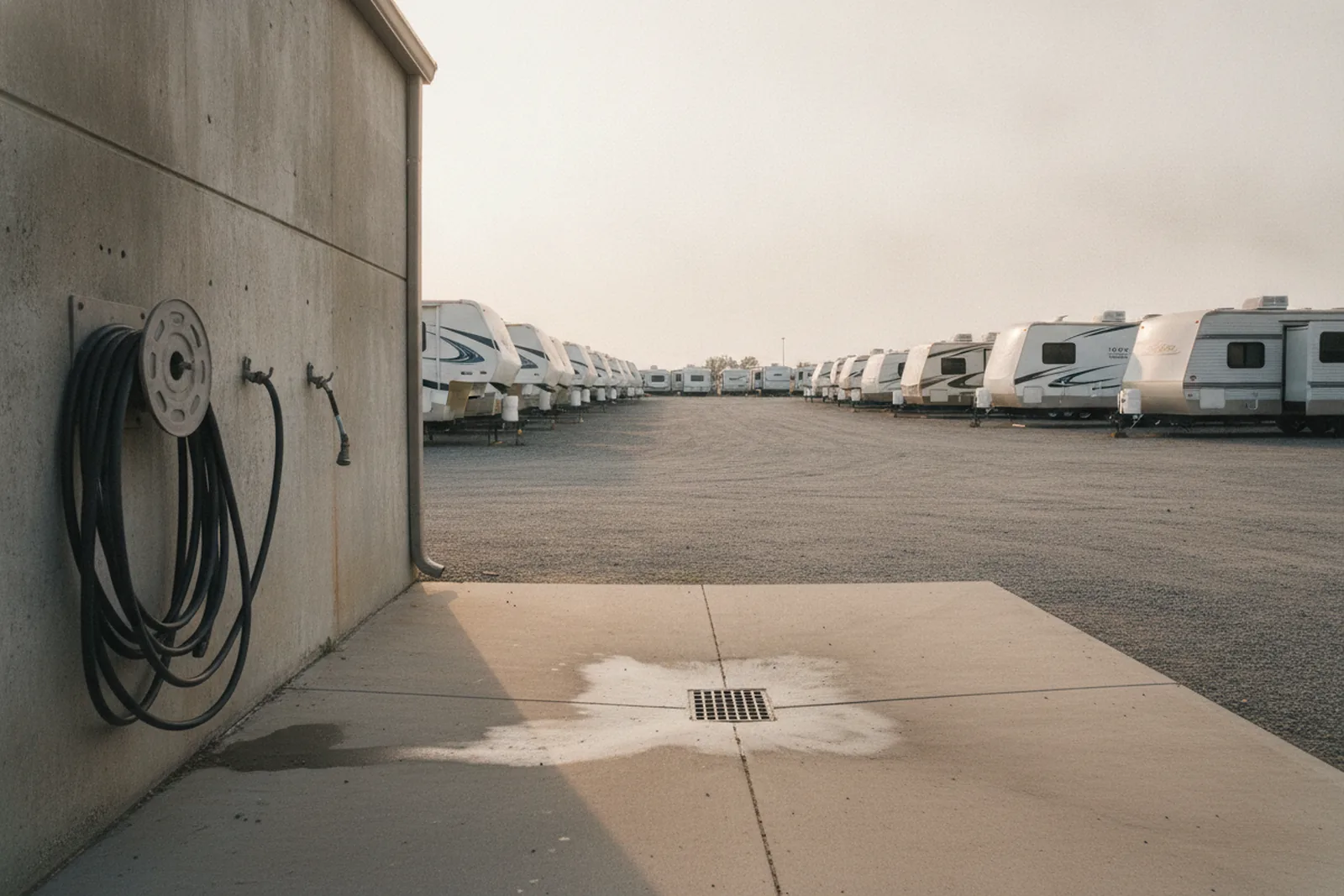
A yard that stores boats usually has the stuff RV owners forget to ask about: a wash-down pad with oil and sand separators, freshwater spigots every four or five rows, and sometimes a dump station for boat heads that doubles as an RV dump.
Some yards sit next to a public boat ramp. That’s both a blessing and a curse.
If you’re comparing boat and RV storage across Florida, ask whether the wash-down pad is open to everyone or just boat customers. At my yard, RV folks could use it on weekdays but not during the Saturday morning rush.
Saturday morning launch rush and the art of not blocking the aisle
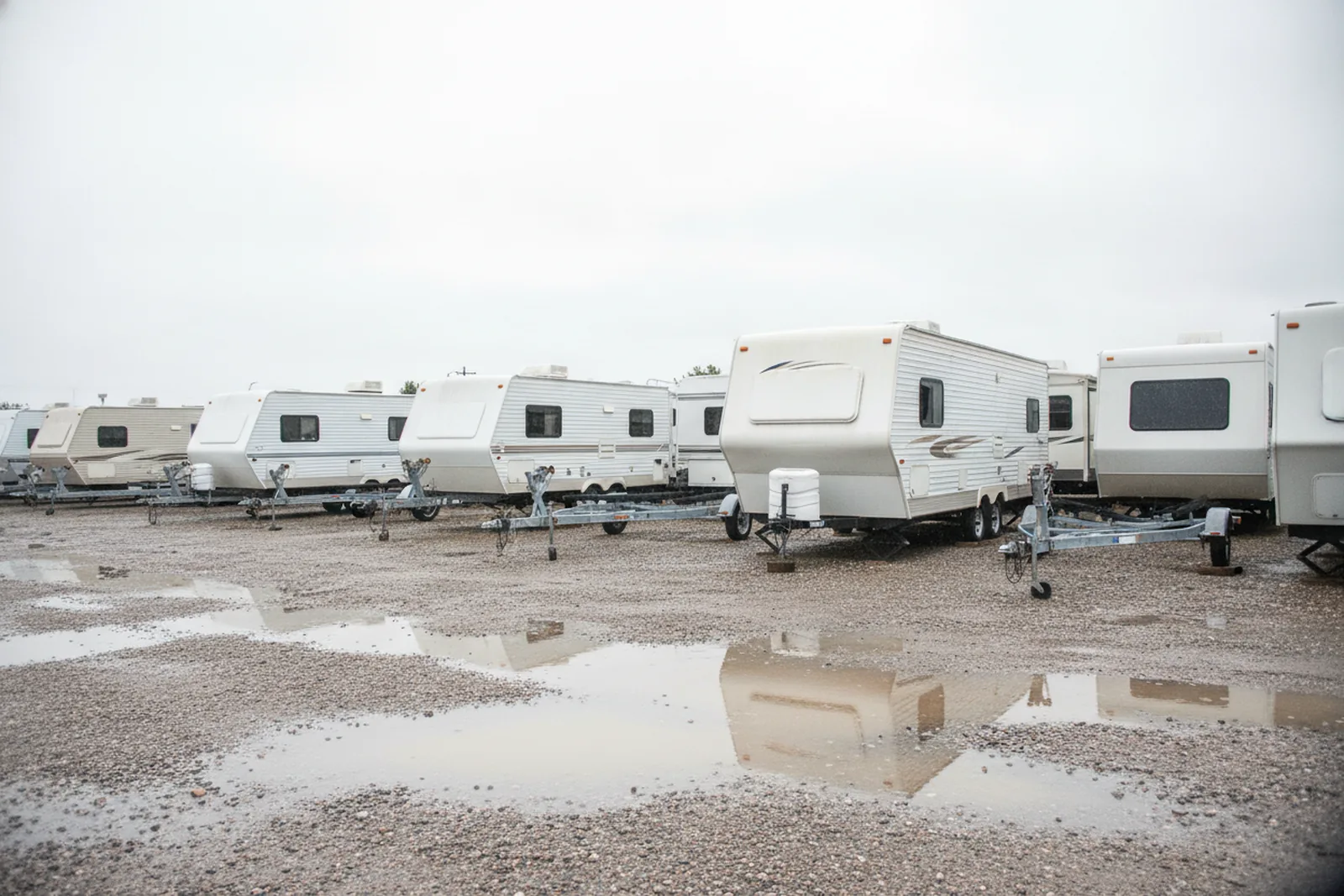
At 6:30 on a summer Saturday, the aisles turn into a one-way road with no traffic control.
The trick I learned from a retiree in row H: plan your departure for Friday afternoon or Sunday evening. Same for arrival. Our gate log showed a huge spike between 8 and 11 a.m. On Saturdays, and a smaller one on Sunday at 5 p.m. When the afternoon storms rolled in.
Tight aisles are the number one complaint in boat yards. Walk the lot before you sign. If the aisle feels tight in a golf cart, it’s worse in your Class A.
Salt air, humidity and what a coastal yard does to an RV
Park a motorhome within two miles of the Gulf and salt air finds every scratch in the paint.
Humidity is the quieter enemy. Mold started on my dinette cushions before I learned to leave a small dehumidifier running on a timer. If you store at a climate controlled RV storage in Fort Myers, you skip that fight, but you’ll pay $300 to $700 a month for it.
What I tell every coastal customer: wash the rig before you park, use a breathable cover if it sits outside, and check the roof seams every six weeks. A $12 tube of self-leveling sealant beats a $4,000 roof replacement.
Hurricane season changes the rules at a Florida storage yard
From June through November, every lease I wrote had a storm clause. Read that clause. Not every yard explains it, and it matters.
Our yard had concrete tie-down anchors every 20 feet. When a Cat 2 was projected to hit, the owner sent a text: “Boats and RVs must be either removed or tied down by noon Thursday. We provide straps, you provide the knots.” Most peopel were grateful. A few argued that there 38-foot Class A was too heavy to blow over. Wind doesn’t read the brochures.
Ask about insurance requirements before you sign. Most yards want proof of comprehensive coverage on your RV. Their own policy covers the fence and the office, not your windshield when a flying boat cushion takes it out. If your rig isn’t registered or road-ready, some facilities wont take it at all. A boat on a trailer with no registration is a boat you cant tow when the sheriff orders an evacuation.
Questions to ask a combined RV and boat storage yard before you commit
I kept a clipboard of questions I wished customers would ask. Half the problems I dealt with came from people who signed the lease without asking one of these.
| Question | What you want to hear |
|---|---|
| Do you require registration and insurance? | Yes, both, and current tags on trailers. If they say no, ask who pays when a rig gets hit. |
| What’s your storm plan? | A written procedure: tie-downs, removal deadline, communication method. “We’ll figure it out” is not a plan. |
| Can I park a second vehicle in my space? | Usually no. If yes, you’ll need a separate gate code and sometimes a small monthly fee. |
| Are aisles designed for a long RV or a boat trailer? | Wider than 25 feet for two-way traffic with a 30-foot rig. Walk it yourself. |
| Is the lot paved, gravel or dirt? | Paved or compacted gravel. Dirt that floods in July means water in your wheel bearings. |
| What are the gate hours and weekend rules? | At least 6 a.m. to 9 p.m., and no hours when the launch line blocks the entrance. |
| Do you require a specific lock or have an admin fee? | A simple cylinder lock is fine; an admin fee under $30 is normal, more than that is a red flag. |
If the manager rolls their eyes at the storm question, walk away. A combined yard without a hurricane plan will call you after the storm to say “your RV is on its side, please move it.” For more on where to keep your rig when the HOA says no,see our post on RV storage ideas.
I found a video that walks through the ups and downs of investing in boat and RV storage, and it matches what I’ve seen from the office window.
The one test I’d run before signing any yard lease
Drive over on a Saturday at 9:30 a.m. And watch the gate for ten minutes. If three pickups with boat trailers make a loop and leave because there’s no room, that’s your answer. The yard will be too tight for your motorhome on the days you actualy want to use it.
I’d also look for a yard that lets you pull through when you arrive, not back in. Pull-through spaces cost maybe $20 a month more, but they spare you a Sunday night argument with a boat trailer that has no reverse lights.
Check the latest RV and boat storage rates in your city this week. The good yards fill up before spring break and before snowbird season. Call two or three, ask the storm plan question, and if you get a straight answer, go stand in the aisle yourself. That’s the test no website can take for you.
Related reading
FAQ
Does a boat stored on a trailer cost more than an RV at the same yard?
No. Both are priced by the length of the space they occupy, typically in 5-foot increments like 10 by 30 or 10 by 40. A 27-foot boat on a dual-axle trailer needs a 32-foot space, so it rents the 10 by 35 at the same rate as a 30-foot travel trailer. Price depends on total length, not vehicle type.
Do I need to winterize my RV if I store it at a boat yard in Florida?
Not for freezing, but you should still winterize against humidity and pests. Dump and flush the tanks, pour RV antifreeze into the traps to keep seals wet and block sewer gas, and leave moisture absorbers inside. In coastal Florida a freeze is rare, but a cracked black tank from an unflushed mess costs more than a gallon of pink antifreeze.
Can I store my RV at a boat storage yard if it's not registered or insured?
Most yards require current registration and proof of comprehensive insurance before move-in. Their property insurance does not cover your RV if a neighbor's trailer hitch cracks your fiberglass. Some yards will allow unregistered vehicles with a signed waiver, but you won't be able to remove the RV when a hurricane evacuation order hits. Keep both current.
Is a wash-down pad safe for my RV's roof and finish?
Yes, if you use low pressure and a mild soap made for RVs. The pad is designed for saltwater boats, so it has good drainage and usually a soft brush on a long pole. Rinse from the roof down, don't spray directly into the furnace or fridge vents, and dry the awning before rolling it up to prevent mildew.
What should I look for in a hurricane clause at a boat and RV storage yard?
The clause should state a removal deadline, usually 48 to 72 hours before landfall, and describe how the yard will contact you. It should also allow the yard to tie down your vehicle with their straps if you can't remove it. If the clause says "tenant assumes all risk," fine, but you still want a written tie-down procedure and a place to pick up the straps.
How much should I budget for a covered space at a coastal Florida boat and RV lot?
Covered canopies in coastal metros run $100 to $300 a month for a 30-foot space, depending on the city. An enclosed unit at the same size will be $150 to $450. Add another $50 to $100 if it's climate controlled. Prepaying six months offen earns a free month, and some yards waive the admin fee if you move in before March.
Find storage near you
Compare covered, indoor and open RV storage in your city, then ask a few places for their current monthly rate.
Browse by stateOr jump to: Boat storage · Tampa, FL · Albuquerque, NM · Miami, FL