Indoor RV storage: what you actually get inside the building
By Jenna Halvorsen · October 29, 2026
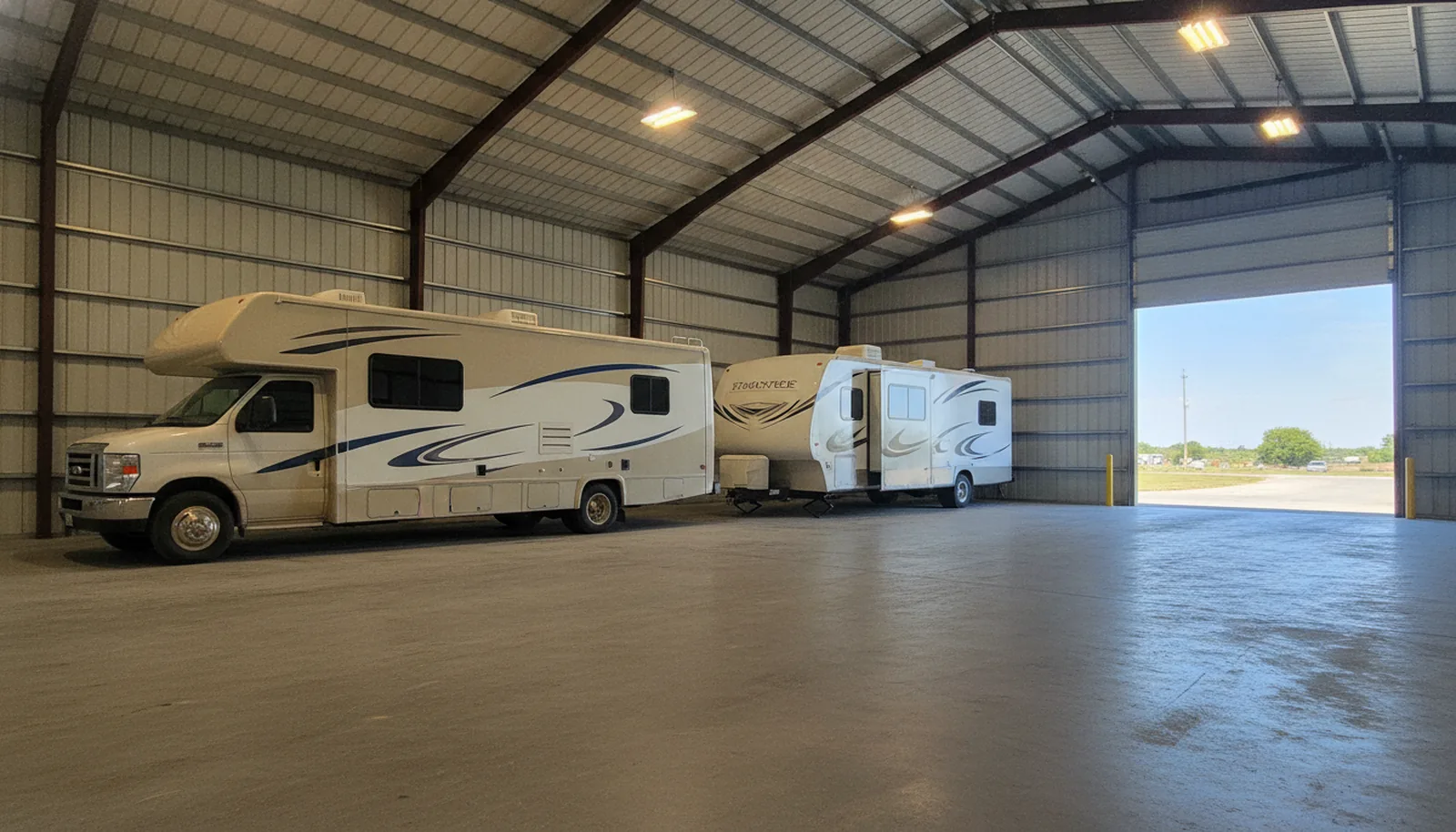
I worked the front office at a boat and RV storage yard in Southwest Florida for four years, and one Saturday morning in July still sticks with me. This customer showed up at 9 a.m. To grab his fifth wheel for a two-week trip to the Keys. Problem was, his rig sat in the back row of our indoor warehouse, similar to what you’d find at indoor RV storage in Orlando, and we needed 48 hours to dig it out. Nobody had told him that. So he stood in my office holding his keys while I tried to page a forklift driver who wasn’t on shift. After that I started telling every indoor custumer the same thing: read the access rules twice, then call the office and hear somebody say them out loud. Because before you sign anything, compare what’s actually inside an indoor RV storage building. The doors, the humidity, the fine print all vary more than the monthly price does. Start with a look at indoor RV storage nationwide, then check indoor RV storage in Orlando if central Florida is your area.
I’ve parked my own 24-foot Class C in an indoor bay, and I’ve seen the good, the damp and the mouse-infested. Walk through the details before you hand over a deposit.
If you’re comparing buildings in central Florida, the Orlando listings are a decent starting point, and you should check climate controlled spots in Orlando if humidity keeps you up at night.
Shared warehouse or private bay: who holds your keys?
Indoor RV storage comes in two versions. Don’t confuse either one with covered RV storage in Orlando, which keeps the sun off but not the humidity. The first version is a shared warehouse, usually a metal building with high ceilings and rigs parked nose to tail. Sometimes they stack them with forklifts. Staff move the rigs for you, so you hand over a set of keys and a schedule. The secound version is a private drive-in bay, basically an RV-sized garage with your own roll-up door and a keypad code. You keep the keys and come and go when the gate is open. The shared warehouse usually runs cheaper per foot, but a private bay means your coach stays under your control. Ask who holds the keys before you put down a deposit, because that answer changes evry other rule on this list. And compare monthly RV parking in Orlando to see what the valet places actually charge.
I’ve watched customers balk at handing over keys. Then they realize the alternative is backing a 40-foot Class A into a 45-foot slot with six inches of mirror clearance on each side. A valet warehouse starts looking pretty good after that. But valet service means valet hours, not 24-hour access. If you want the line-by-line diffrence between indoor buildings and plain parking spots, our guide to RV storage units covers it. Which brings up the thing valet customers forget until it’s too late: the door itself.
Concrete floors, overhead lights, maybe a wash bay. Those are the usual amenities inside. But if money is tight, outdoor RV storage in Orlando is usually the cheapest way to park.
Door height, width and the Sunday problem
Enclosed RV buildings usually have roll-up doors 12 or 14 feet tall, and the bay width varies by facility. That fits most rigs, but measure your actual height to the top of the AC shroud or antenna before you sign. A Class A with a rooftop satellite dish can top 13.5 feet, and a 12-foot door becomes a very expensive mistake real quick, so check the posted clearance.
Access hours are the hidden fee nobody reads about. Many indoor facilities keep the gate open roughly 6 a.m. To 9 or 10 p.m., but a valet-style warehouse may need 24 to 48 hours of notice to pull your rig out. Read the lease, then call the front office and ask the question straight: “If I’m heading out Sunday morning, can I get my coach Saturday night?” And while you’re on the phone, ask what the building does about the air inside it.
Indoor is not automatically dry: humidity and mold in a closed Florida building
People assume indoor means dry. In Southwest Florida, a closed metal building with no AC turns into a sauna from June through September. Moisture condenses on the cold concrete, and the humidity inside can match the air outside, 80 to 90 percent. I’ve opened bay doors and watched water drip from the roof trusses onto a travel trailer. Mold grows on cushions, wood swells, electronics corrode. If the building isn’t climate controlled, treat it like a fancy carport with walls. Run a dehumidifier if power allows, or at least leave cabinet doors open and use moisture absorbers, and check the facility’s rules on dehumidifiers. For real temperature and humidity control, look for climate controlled RV storage in Orlando, but expect to pay $300 to $700 a month or more.
Even without AC though, indoor still beats open air by a long shot. Just know that a dry building is not the same as an empty one.
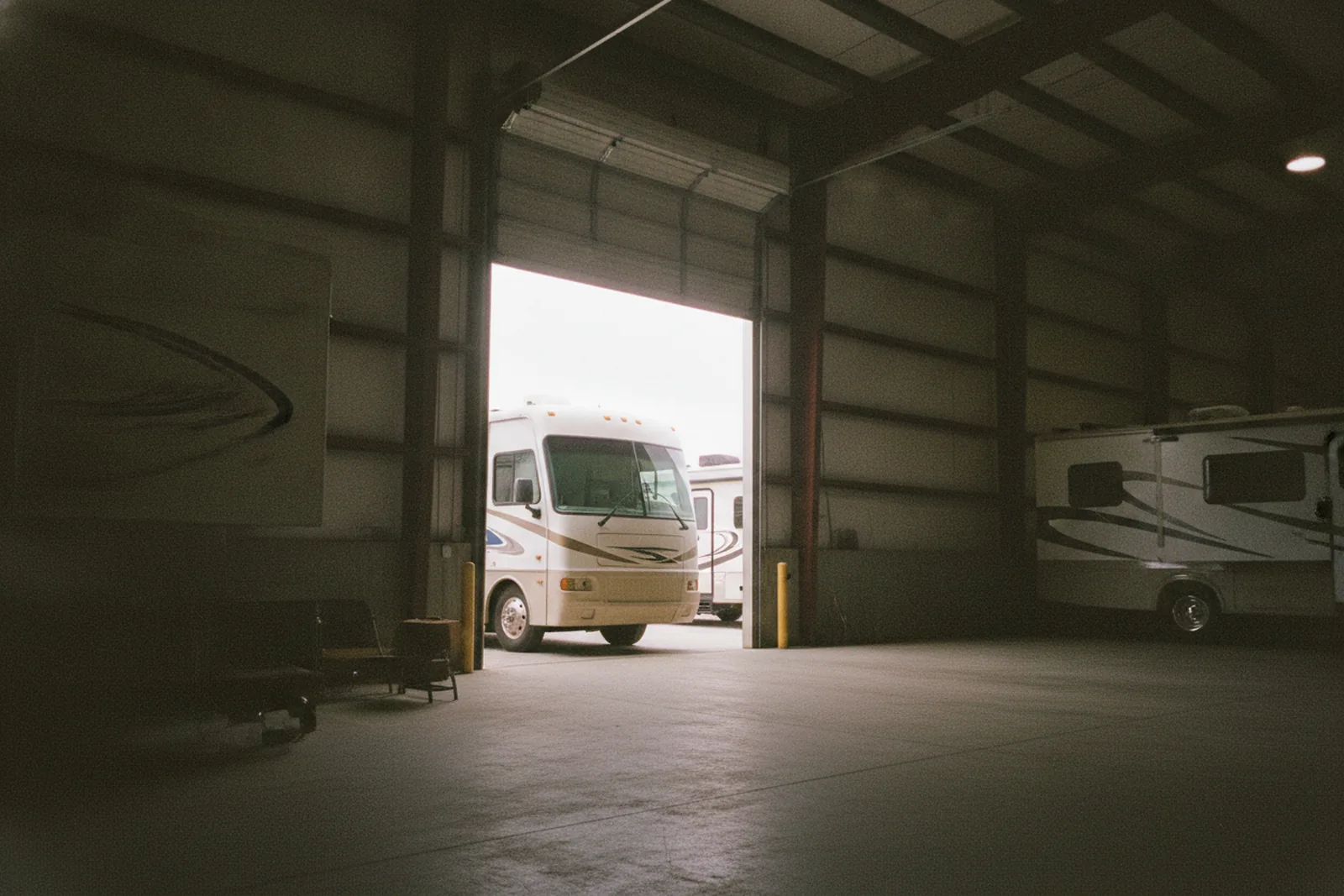
Pests and the neighbor’s rig problem
Mice and rats love indoor RV storage. The building gives them shade, and your rig gives them a nesting spot. I’ve seen a customer’s wiring harness chewed to ribbons in a supposedly sealed warehouse. Do your own defense: remove all food, seal gaps with steel wool, set traps before you lock the door.
Insects are less dramatic but just as persistent. Keeping your rig clean helps, but you’re still parking inside a building with a hundred other potential bug carriers. I keep a can of roach bait in my Class C’s storage bay year-round. Cheap insurance. And then there are the rules that can get you kicked out faster than any bug problem.
Fire rules: propane off, fuel limits and battery disconnects
Most indoor buildings are not built for an RV fire, so the rules tend to be strict.
Batteries are the sneaky one. A propane detector or stereo memory can drain a battery in a few weeks, and a dead lead-acid battery can freeze in a cold snap. Many indoor facilities require the battery disconnect switch to be off, or the negative cable pulled. Whatever the rule says, follow it. I once saw a battery boil over in a hot building and eat a hole straight through the battery tray, which is why you should keep the battery charged and follow the facility’s disconnect rules.
If you have questions about keeping your rig safe in storage, our post on RV storage ideas goes beyond the building to cover at-home and alternative spots. But safety only matters if you can actually get a spot.
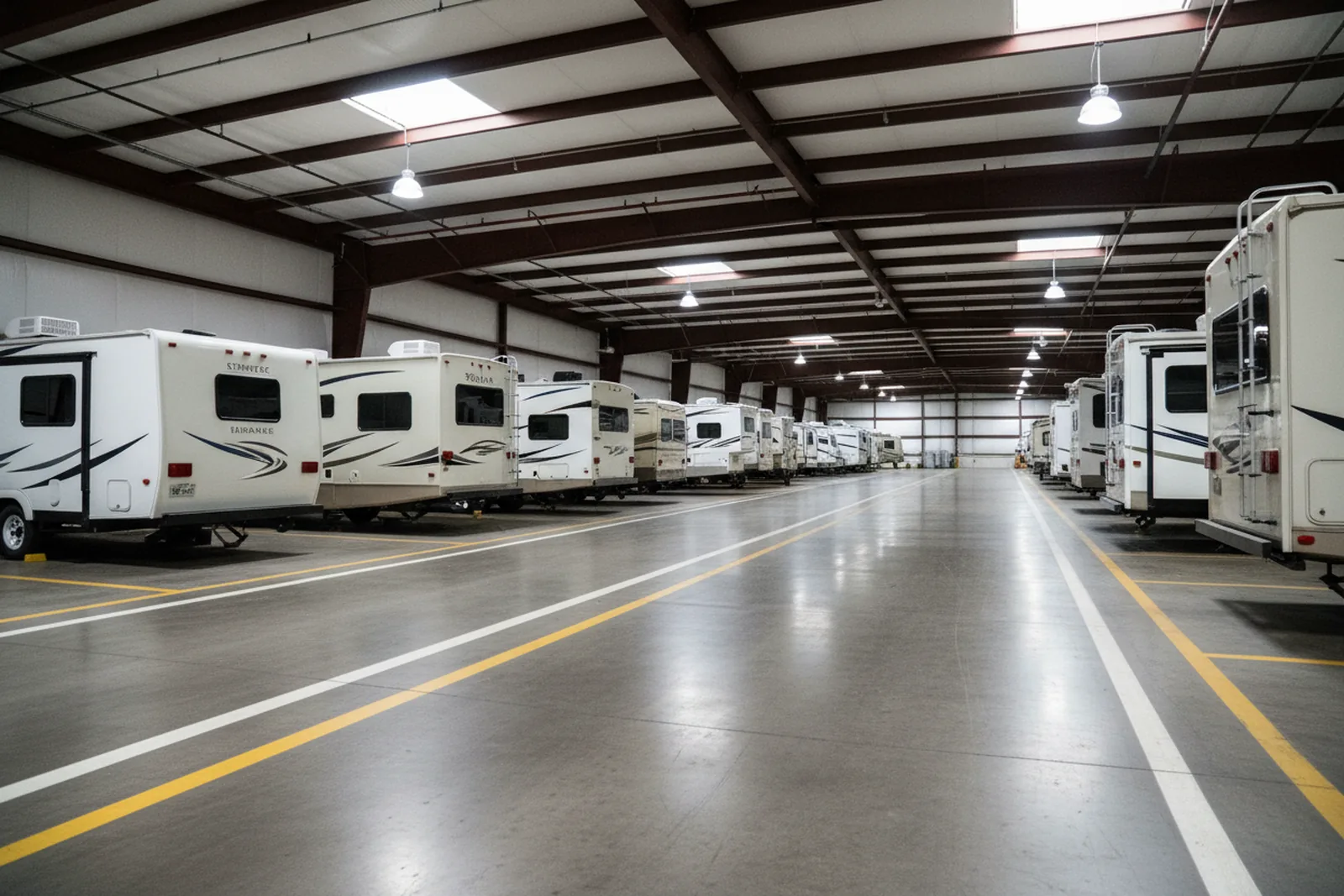
Rent position: indoor vs covered and open, what the range looks like
Indoor RV storage runs roughly $150 to $450 a month accross the US, with longer bays for 40-foot coaches pushing higher. My first indoor bay for the Class C was $189 a month in Fort Myers, and that was a deal because the waitlist was three months deep by August.
When you’re comparing, put indoor next to covered RV storage in Orlando and outdoor RV storage in Orlando to see the spread. Also check monthly RV parking in Orlando for short-term or month-to-month rates. Our indoor building filled to capacity by Memorial Day every single year, and the only openings was cancellations. One customer drove from Naples to Fort Myers twice a week for a month, hoping for a spot. When a spot does open, you’ll have about twenty questions to ask before you sign.
If you’re wondering how much indoor RV storage costs in Virginia, this video gives a real look at prices.
Indoor RV storage questions to ask before you sign
Print this table or copy it into your phone.
| Question to ask | Why it matters |
|---|---|
| What’s the overhead door height and bay width? | Measure your RV’s tallest point; a 12-foot door may not fit a 13.5-foot Class A |
| Do I keep my keys or hand them over? | Valet storage means staff move your rig; you lose 24-hour control |
| How much notice to pull my rig out? | Some valet buildings need 24 to 48 hours; plan ahead |
| Is the building climate controlled? | No AC means high humidity and possible mold in summer |
| What are the propane and fuel rules? | Many buildings require tanks off and fuel caps; ask before move-in |
| Is there power in my bay for a battery maintainer? | Without power, you may need to pull the battery |
| What’s the pest control plan? | Indoor buildings can harbor mice; ask what they do |
| What’s the monthly rate and is there a waitlist? | Get the price in writing; ask if rates rise after the first few months |
Ask about move-out notice too. Some contracts require 30 days written notice, and if you forget, you pay another month. I had a tenant who moved his coach out without telling us and then argued the bill for two months. The lease said 30 days. The lease won. So how do you sort the good buildings from the ones that’ll nickel-and-dime you? Call them.
Call two buildings and ask the notice question first
Indoor RV storage is the best money you can spend on a rig in hurricane country, but only if you know the rules before you need the rig.
So here’s my test for this weekend: look up indoor storage listings in your own city, pick two buildings, and call them. Ask one question: “If I want to leave Saturday morning, when do I have to tell you?” Then hang up and compare the answers to the price. You’ll find out real fast if you’re renting a garage or a very expensive box.
Keep reading
FAQ
What is indoor RV storage?
Indoor RV storage means your motorhome or trailer is parked inside a building,either a shared warehouse where staff move rigs or a private drive-in bay with your own roll-up door. It protects from sun, rain and hail but is not automatically climate controlled. Prices typically range from $150 to $450 a month, more for longer bays.
How much does indoor RV storage cost per month?
Most indoor RV storage spaces cost $150 to $450 a month. A 40-foot Class A in a long bay can run higher, and heated or climate controlled indoor storage runs $300 to $700 or more. Rates vary by location; big coastal cities are more expensive, and rural lots 20 minutes outside town are often cheaper.
What is the difference between indoor and climate controlled RV storage?
Indoor RV storage means the rig is inside a building, but the air inside may still be humid and hot. Climate controlled storage adds heating and cooling to keep temperature and humidity in a safe range, but the exact settings vary by facility. Climate controlled is the most expensive option, offen $300 to $700 a month, and not all facilities offer it.
Can I get my RV out of indoor storage on short notice?
If you rent a private drive-in bay with your own code, you can usually come and go during gate hours. But if it's a valet-style warehouse where staff move the rigs, most require 24 to 48 hours notice to pull your coach out. Ask before you sign, or you may find yourself waiting on a forklift driver on a Saturday morning.
Does indoor RV storage prevent mold and mildew?
Not automatically. A closed metal building without air conditioning can trap humidity, especially in Florida summers. Indoor storage stops rain and UV, but mold can still grow if the rig is closed up with moisture inside. Use a dehumidifier or moisture absorbers, and consider climate controlled storage if you're worried about mold.
What are the propane rules for indoor RV storage?
Most indoor facilities require you to turn off the propane tanks at the valves, and some may require you to remove portable tanks, especially on travel trailers and fifth wheels but rules vary by facility and local fire code. Motorhomes with fixed tanks usually just need the valve closed. The exact rules vary by facility and local fire code, so ask the facility before you move in.
Do I need a cover for indoor RV storage?
Usually not. Indoor storage already protects against sun and weather, and a cover inside a building can trap moisture against the finish, which is worse then dust. If the building has birds or dirty rafters, a breathable cover may help, but most indoor renters skip it. Tire covers aren't needed inside either.
Find storage near you
Compare covered, indoor and open RV storage in your city, then ask a few places for their current monthly rate.
Browse by stateOr jump to: Indoor RV storage · Memphis, TN · Tampa, FL · Albuquerque, NM