RV Storage Buildings: Steel, Pole Barn or Stick-Built Costs
By Dale Pruitt · November 1, 2026
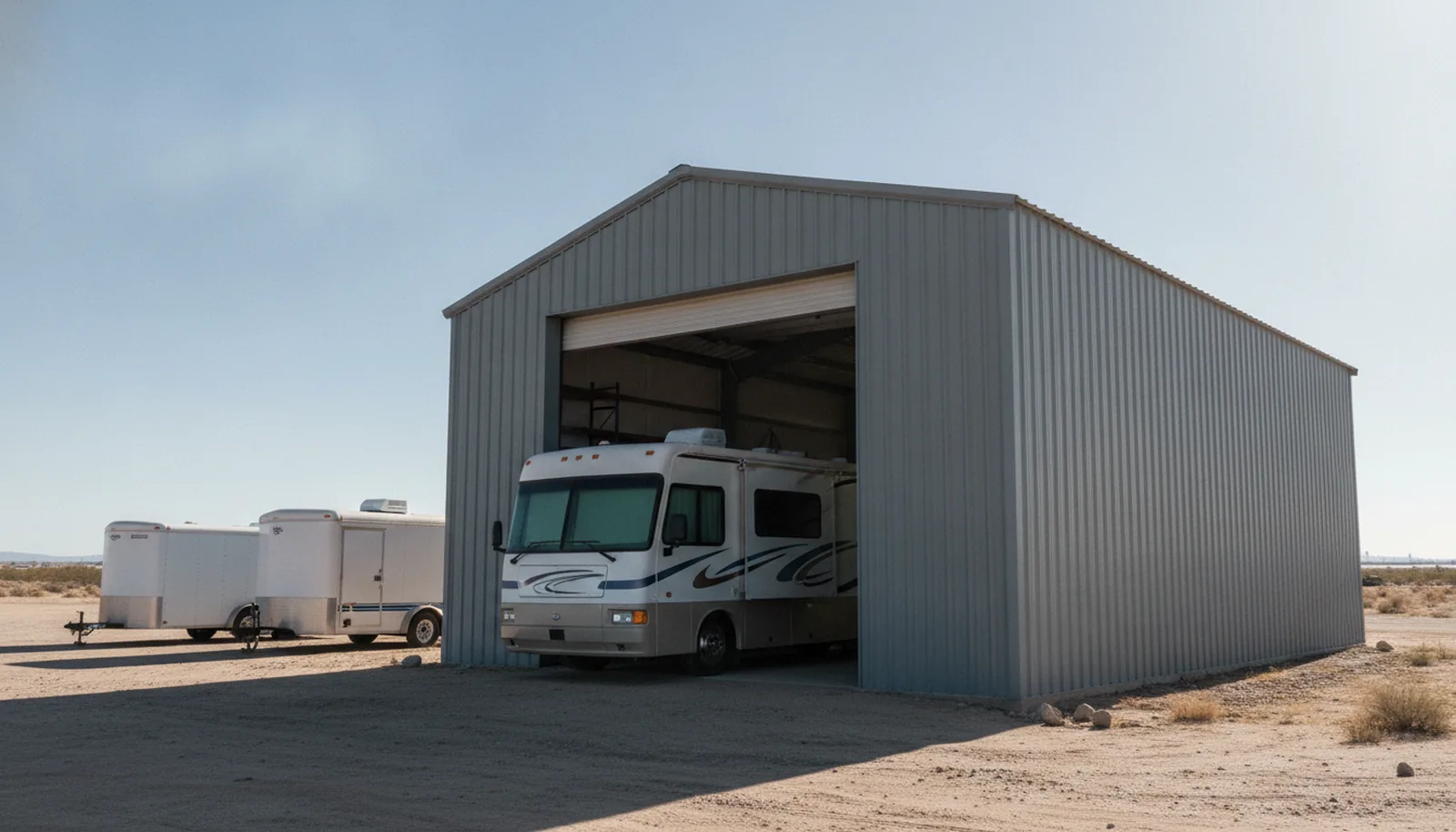
Last June I stood in a buddy’s bare acre outside Tucson while a contractor priced me a steel building to park my 36-foot Class A under, and I’ve since compared RV storage buildings and RV storage across Arizona. It was 104°F and I was sweating through my hat. He rattled off a number around $41,000 installed, which makes climate controlled RV storage in Tucson look cheap by comparison. I laughed, then I did the math on what indoor RV storage in Tucson was costing me every month. That number didn’t laugh back.
The sticker price on an RV storage building is rarely the insult. The slab, the permit, the door height you forgot to verify, the HOA you didn’t think would care. I’ve priced all three common types for my own rig, and I’ll lay out the real costs below, including monthly RV parking in Tucson. A covered RV storage in Tucson spot can be a better deal then building. Sometimes.
Size the door first: 14 feet tall is my baseline
Measure your RV to the top of the AC shroud, not the brochure height. My Class A pusher is 13 feet 2 inches at the tallest point. A 12-foot door is useless for me. A 14-foot door works. That’s what I’d get if you ever want a big fifth wheel or another coach later.
For width, most RV storage buildings use a 12- or 14-foot-wide door. Mine is 102 inches wide at the the mirrors. A 12-foot door leaves about 20 inches of clearance on each side if I come in perfectly straight. Depth is easy: add 6 feet to your rig’s lenght so you can walk around the back and still close the door. My 36-foot coach wants 42 feet. I’d bump that to 45 feet for a a workbench. Outdoor RV storage in Tucson can be had for a fraction of all this.
RV storage buildings: three ways to build, three price ranges
A steel building kit, a pole barn, or stick-built. That’s the choice. Each one costs different money and builds on a different schedule.
- Steel building (prefab or kit): I priced a 45x16x14 clear-span steel building for my buddy’s land at $18 to $28 per square foot for the shell, depending on gauge and snow rating. That’s $12,960 to $20,160 for a 720-square-foot footprint, plus slab and erection. Enclosed steel kits start around $15,000 and climb to $35,000 or more for my size, befor concrete.
- Pole barn (post-frame): In Arizona and the Midwest, pole barn contractors quote $20 to $45 per square foot for a fully enclosed building with a concrete floor. A 45x16x14 pole barn for my rig landed around $25,000 to $40,000 from three builders I called.
- Stick-built garage: Conventional framing, trusses, siding, shingles or metal roof. For a building big enough for a Class A, expect $40 to $80 per square foot. That’s $28,800 to $57,600 for my 720 square feet, and that’s if the contractor’s pencil is feeling generous.
The slab is the part that surprised me
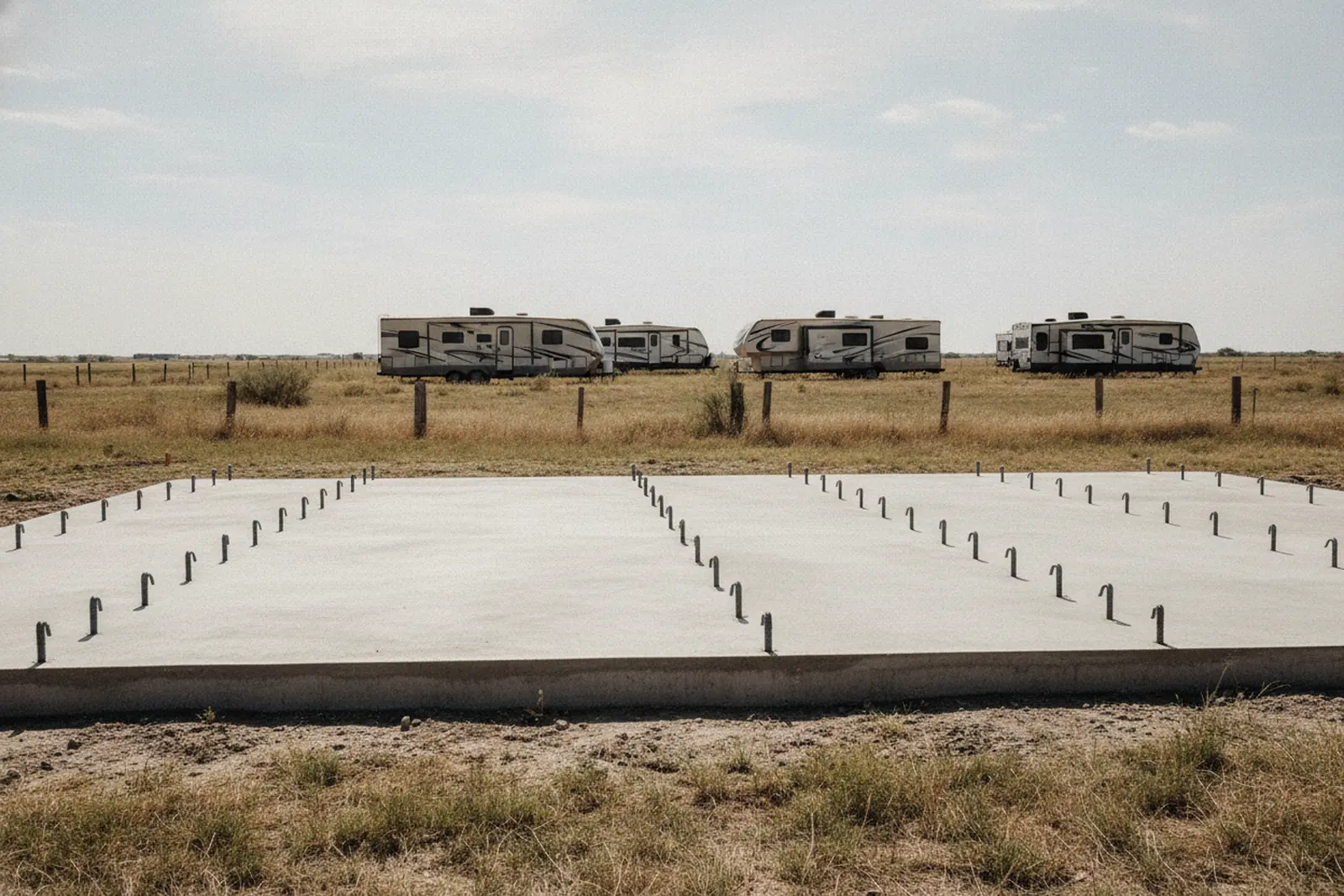
I knew the building would cost money. I didn’t expect a 720-square-foot slab to run $7,200 to $8,600. Concrete runs $6 to $12 per square foot installed for a 4-inch slab with rebar or wire mesh. A 6-inch slab for a heavy diesel pusher costs 50% more.
Don’t forget the apron. You’ll want a concrete approach in front of the door so you don’t rut the gravel and drag mud inside. Budget another $800 to $2,000 for a 10-foot by 16-foot apron.
Permits, setbacks, HOA rules. All three can kill a project before you order steel. I checked the county permit office website before I ever priced a building. Most cities and counties require a permit for any structure over 200 square feet, and they want engineered drawings stamped by a licensed engineer in high wind or snow zones. Setbacks vary. In Pima County the side setback for an accessory structure is 5 feet on most rural lots, but HOAs can impose their own 20-foot rules. My buddy’s HOA had a blanket ban on metal buildings over 12 feet tall. He found out at the first board meeting, not from the contractor.
If you’re thinking about a carport instead, I’ve covered the open-sided option in my RV storage ideas post.
Wind and snow load ratings are on the quote for a reason
Any steel building kit worth buying comes with a wind and snow load rating. Mine was spec’d for 120 mph wind and 20 psf ground snow. Overkill for the Sonoran Desert but fine for less worry. In northern states you’ll need 30 to 60 psf ground snow, and that adds bracing and price.
Ask the seller for a copy of the engineered drawings before you pay a deposit. If they can’t produce a stamped drawing for your city’s code requirements, find another seller. The purlin spacing and the base plate anchors change. Your permit office will check.
Insulation and condensation: steel sweats, and your coach pays for it
An uninsulated steel building in Tucson in July will hit 130°F inside. I don’t need to cook the whole coach.
Condensation is the other killer. Cold steel walls at night plus warm monsoon air equals water dripping onto your roof and down the sides. That leads to mold, rust on the frame, and delamination on the sidewalls. I’d spend the extra $3 to $6 per square foot for closed-cell spray foam on the ceiling and roof. Cheaper than a body shop later.
What each type costs to build and what you get
Here’s the comparison I built for my own decision, based on quotes around Tucson and Phoenix in 2024:
| Type | Typical cost range | Build time | Pros | Cons |
|---|---|---|---|---|
| Steel kit building (enclosed) | $18 to $28 per sq ft (shell only) | 2 to 4 weeks after concrete | Cheapest enclosed option; clear span; low maintenance; goes up fast | Needs crane or crew; looks industrial; condensation if uninsulated |
| Pole barn (post-frame) | $20 to $45 per sq ft (complete) | 3 to 6 weeks | Good price to strength ratio; adaptable for lean-tos; can build tall | Wood posts in ground can rot if not treated; less common in cities |
| Stick-built garage | $40 to $80 per sq ft (complete) | 2 to 4 months | Matches house; best resale; can be insulated easily | Most expensive; needs architect or engineered plans; longer build |
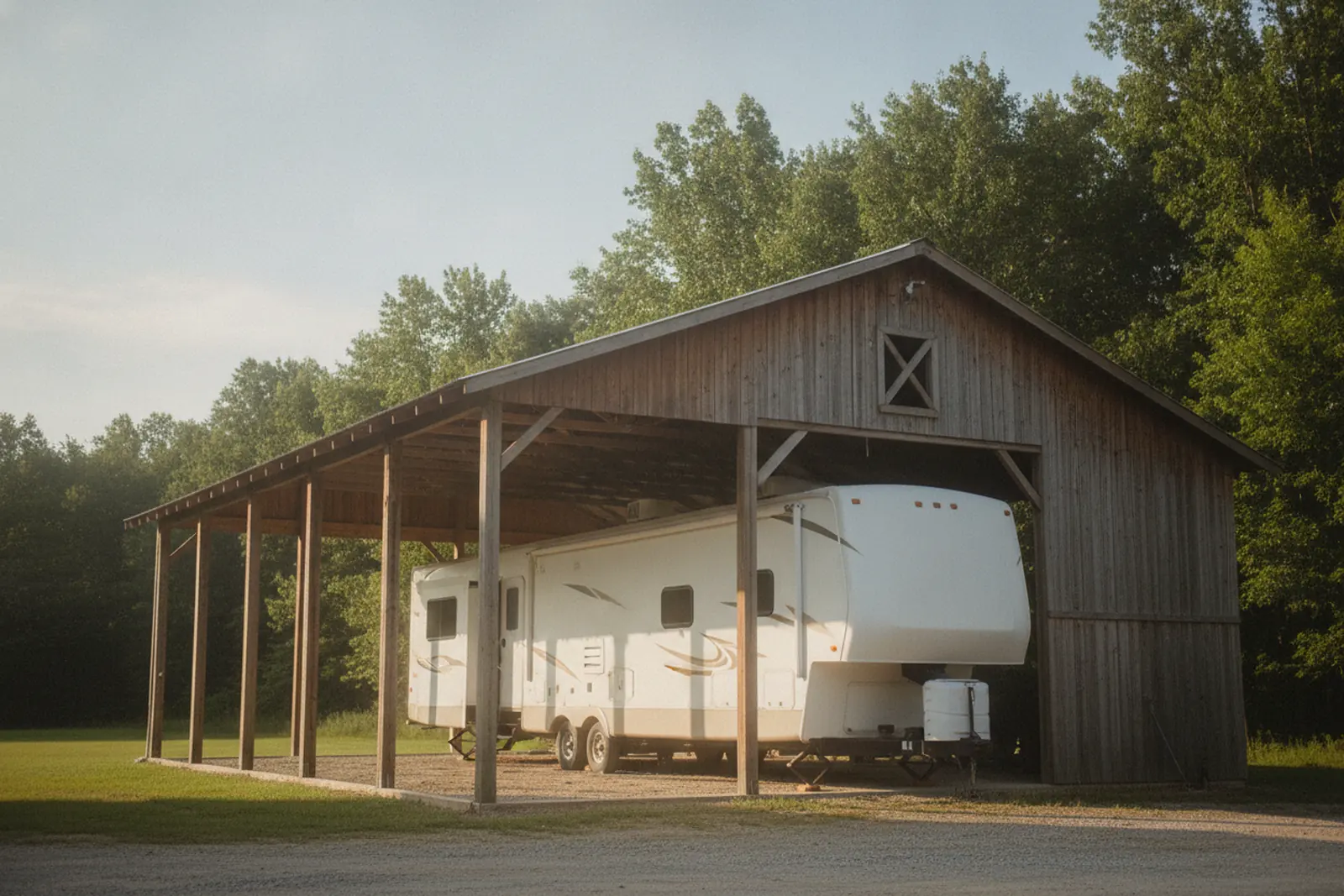
A basic steel carport with no walls runs $4,000 to $12,000 installed for a single RV bay. That’s the cheapest way to get a roof over the coach, and it’s what I’d tell anyone on a budget to look at first.
I found a video from a builder who breaks down his actual costs for an RV storage barndominium. Worth a watch if you want real numbers.
Resale value and property tax: the building giveth, the county taketh
A permitted, stick-built RV garage on a residential lot adds real appraised value. A steel building on a rural acre adds less, and a carport may add nothing. County assessors in Arizona tax accessory structures as improvements, and my friend’s steel building added about $18,000 to his assessed value. That moved his property tax bill by a couple hundred a year.
When you sell, an RV garage is a niche feature. Don’t build it for resale. Build it because you need somewhere to park your rig out of the sun. If you want to know what others do, my cheap RV storage post in Tucson covers the alternatives and what people realy pay month to month.
What I’d do over, and what you should price this weekend
If I had it to do again, I’d pour the slab 6 inches thick with a vapor barrier, order a 14-foot-tall door with a 14-foot-by-14-foot opening, and put a steel building up with a ridge vent and foil-backed insulation. I’d skip the stick-built for cost. I’d skip the pole barn only becuase my friend’s HOA wouldn’t approve it. That’s the real variable: your neighborhood rules.
Then you’ll know which way to build, or whether to keep renting from a place with a gate and a wash bay. I did the math. I’m still paying the facility every month. The slab in my buddy’s yard is where his fifth wheel sits now, and that’s fine, he likes it. His HOA still doesn’t.
If you’re still deciding
FAQ
What size RV storage building do I need for a 36-foot Class A?
I’d go at least 14 feet wide by 16 feet tall by 45 feet deep. That gives clearance for a 13.5-foot coach with AC and room to walk around. A 12-foot door is too tight for most Class A rigs. Measure your own height to the top of the AC before you order.
How much does a steel RV storage building cost in 2024?
An enclosed steel kit runs $18 to $28 per square foot for the shell, so a 45x16 building is roughly $12,960 to $20,160 before slab and erection. A basic steel carport with no walls is $4,000 to $12,000 installed. Prices vary by gauge, wind and snow rating, and region.
Is a pole barn cheaper than a stick-built RV garage?
Usually. Pole barns run $20 to $45 per square foot complete, while stick-built runs $40 to $80 per square foot. Post-frame construction uses fewer materials and labor, but some HOAs and city codes won’t allow metal siding in residential zones, so check rules first.
Do I need a permit for an RV storage building?
Yes, in most places. Any structure over 200 square feet or any building with a concrete slab usually requires a building permit. You’ll need engineered drawings stamped by a licensed engineer for wind and snow loads. Skipping the permit can get you a stop-work order and a fine.
How thick should the concrete slab be for a diesel motorhome?
Six inches reinforced with rebar or wire mesh. A loaded Class A can weigh over 30,000 pounds, and concentrated tire loads will crack a 4-inch slab over time. Use a vapor barrier underneath and a 6-inch compacted gravel base. The slab is offen the most expensive single item.
Does an RV storage building add to property value and taxes?
Yes to both. A permitted stick-built RV garage can add real appraised value in a residential area. A steel building on rural land adds less, and a carport may add little to none. The county assessor will increase your property tax by the building’s assessed improvement value every year.
Find storage near you
Compare covered, indoor and open RV storage in your city, then ask a few places for their current monthly rate.
Browse by stateOr jump to: Phoenix, AZ · Jacksonville, FL · Austin, TX